…where east meets west
- Home
- Brief History
- The Greenwich Meridian
- Greenwich
(1675–1958) - Herstmonceux
(1948–1990) - Cambridge
(1990–1998) - Outstations (1822–1971)…
- – Chingford (1822–1924)
- – Deal
(1864–1927) - – Abinger
(1923–1957) - – Bristol & Bradford on Avon
(1939–1948) - – Bath
(1939–1949) - – Hartland
(1955–1967) - – Cape of Good Hope
(1959–1971)
- Administration…
- – Funding
- – Governance
- – Inventories
- – Pay
- – Regulations
- – Royal Warrants
- Contemporary Accounts
- People
- Publications
- Science
- Technology
- Telescopes
- Chronometers
- Clocks & Time
- Board of Longitude
- Libraries & Archives
- Visit
- Search
Decoding Flamsteed: Flamsteed's modus operandi and the methods used to compare, regulate, rate and determine the errors of his clocks (1676-1719)
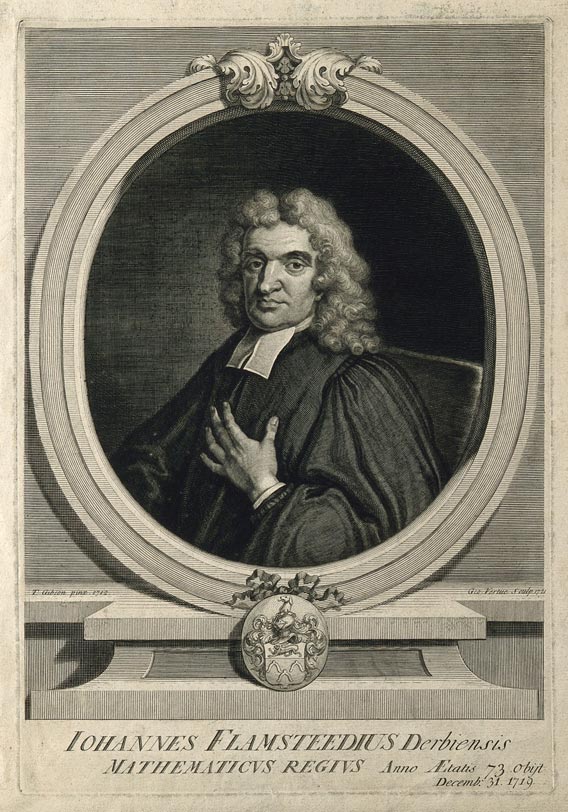
John Flamsteed. Line engraving by G. Vertue, 1721, after T. Gibson, 1712. Image courtesy of the Wellcome Collection (see below)
Over a hundred years later, Derek Howse at the Old Royal Observatory, carried out a detailed study of the clocks from a horological perspective. This was published in two parts in Antiquarian Horology in 1970 & 1971 and subsequently reissued as an off-print under the title The Tompion Clocks at Greenwich and the dead-beat escapement.
What follows is thought to be the first study of how the clocks were used in practice and how the observations were recorded and subsequently published. It is very much a preliminary study. It draws primarily on the following sources:
- The published observations (Historiae Coelestis Libri Duo 1712 & Historia Coelestis Britannica (1725)
- The English translation of the prefaces to the two Historias published in 1982 by the National Maritime Museum under the title The preface to John Flamsteed's Historia Coelestis Britannica (Maritime Monographs and Reports, No.52)
- The Flamsteed archive at Cambridge (RGO1)
- The published correspondence of Flamsteed (over 1500 letters)
- Baily's book and Howse's study of Flamsteed's clocks.
Amongst other things, the Flamsteed archive contains original observing books and the reductions that were subsequently made. Some documents are in Latin and others in English. One of the big unknowns is how complete the archive is. Some of the original observations are known to be lost and some things that might be expected to be there are missing. Three different versions of the catalogue are readily available.
- Baily's catalogue from the 1830s
- The old digital catalogue (the Janus version, now archived)
- The current on line version of the catalogue (ArchiveSearch)
Each is useful in its own particular way. View catalogues.
Introduction
Flamsteed made the great majority of his published observations in three distinct locations: the Octagon Room (1676–1719), the Sextant House (1676–1690), and the Arc House (1689–1719). Each was equipped with its own clock or clocks in the case of the Octagon Room. Flamsteed also had a portable clock.
Until the introduction of atomic time in 1967, the rotating Earth and the length of the day were the basis of our timekeeping system. When the Observatory was founded precision timekeeping was still very much in its infancy. It had long been known that natural days varied slightly in length and that the difference between apparent and mean solar time varied during the course of the year. Today this difference is known as the equation of time. In Flamsteed's era, it was sometimes referred to as the equation(s) of natural(l) day(e)s. Prior to becoming Astronomer Royal and even before he owned a clock of his own, Flamsteed had published a paper on the equation of time – De temporio aequatione diatriba (1672). It can be found as an appendix to John Wallis's Jeremiae Horrocci opera poshuma (1673) and in the later edition of 1678.
Many astronomers believed that the Earth was rotating at a steady rate (i.e, that it was isochronal) – but nobody had yet be able to show it, not least because prior to the invention of the pendulum clock by Christiaan Huygens in 1656, nobody had a sufficiently accurate timekeeper to do so.
In the early 1690s, Ole Rømer was the first to design and use what has since become known as a transit telescope. In 1721, a year after Flamsteed's death, the Observatory acquired its first such instrument. Its key role was to delineate a meridian and maintain it as a standard of adjustment for the other instruments, most notably the 8-foot Iron Mural Quadrant by George Graham, installed in 1725. Like the later transit instruments it was also used for the determination of time.
Transit Instruments consist of a telescope mounted between two piers in such a way that it can only point higher of lower in the plane of the meridian. By 1750 and until 1871, the Transit Clock (i.e. the one used with the Transit Telescope) was the Observatory's de facto sidereal standard – the clock to which all others (including those set to mean solar time) were ultimately referred. The Transit Clock itself was checked by comparing it with the rate of the Earth's rotation using the telescope. Certain of the brighter stars, whose positions had been refined by repeated observation over a long period of years, were used as ‘clock stars’ to determine the errors of the Observatory’s clocks and hence the local time at Greenwich. In 1851 for example, some 67 clock stars were kept under observation for this purpose. With the help of a good clock, astronomers were able to reverse the process and determine the right ascensions of stars from their times of meridian transit.
When Flamsteed became Astronomer Royal in 1675, he considered the best available star catalogue to be that produced by Tycho in 1598 long before telescopes, pendulum clocks, logarithms and the micrometer screw had been invented. Even if transit telescopes had existed when Flamsteed started work at Greenwich, they would not have been much use for determining accurate clock times as the star positions in the existing catalogues were not of sufficiently accuracy ... and it was, after all, partly to improve these catalogues, that the Observatory had been founded. Given the absence of any established 'clock stars', Flamsteed needed to find a different way of compiling his catalogue. The methods he used built on those of Tycho and were the precursor of those used by his successors.
Treading in Tycho's footsteps
In 1669, at the age of 23, Flamsteed began a correspondence with the Royal Society. In a letter dated 19 April 1673 sent to its Secretary Henry Oldenberg, he wrote:
'had the latitudes of the fixed star of Tychoes constitution beene exact and coherent, wee should easily have determined the praecise quantity of this inclination [the Eclipick], and those regular inequalityes wee find in this and in all the other planets which are found irrepresentable by numbers, onely by reason of some latent errors in the places and latitudes of the fixed: wee can expect no great effect from Hevelius his endeavors since hee uses no glasses. It would be a takske [taske] deserveing the paines and accuracy of Cassinus, and of all others, worthy the French observatory, to endeavor the restoreing of these fixed stars especiall those which lie neare the ecliptick. had I onely a large 7 foot Wall quadrant, a Sextans or octans of the same radius, a convenient place for observeing, one good pendulum clock and a ready assistant, I should not doubt in a few nights. to rectifie a many of Tychos errors and add some stars to his cataloge as well visible to the bare eye, yet omitted, as Telescopicall: but this apparatus being beyond my facultys, I can onely, as it were, dreame of, and wonder that amongst so many ingenious persons of large estates there should be none that dares adventure at so small charges, as this provision requires, to undertake this worke whereby hee may raise him a selfe a name greater then Tychos, and a monument with posterity - aere perrenius [more enduring than bronze]:'
As an aside, it is worth comparing the manuscript copy of the letter with the edited version that appeared in Philosophical Transactions, where amongst other cuts, the derogatory comment about Hevelius has been removed (Phil Trans R.Soc. 1673, Vol 8, 6033-36).
At this point in time, it would appear that Flamsteed's planned to measure the positions of the fixed stars in much the same way as Tycho, i.e to measure declination with the wall quadrant fixed in the plane of the meridian and to triangulate his way around the sky by measuring the angular distance between pairs of stars with the Sextant.
When he became Astronomer Royal, these were the instruments together with a pair of clocks that he was provided with by his patron Jonas Moore. There is no indication that he planned to use the Mural Quadrant with a clock to measure right ascensions. In the preface to the 1725 Historia he merely states 'I asked that a quadrant or arc be made first, for measuring the meridonial altitudes or distances of the fixed stars from the vertex: and this was promised to me' (Preface 1982, p.118).
No record has yet been found that suggests that the the deviation of the Quadrant from the meridian at different points was ever measured as part of a calibration process – something that would have been essential if the instrument was to be used for finding right ascensions with the help of a clock. Having said that, since it rapidly became apparent that the Quadrant was not fit for purpose, Flamsteed may have thought it not worth his while to calibrate it and by 1678 seems to have stopped wasting any more time
with it.
With no immediate prospect of a replacement instrument, Flamsteed found a way of measuring a number of 'meridonial distances of the stars' from the vertex with the Sextant (Preface 1982 p.119). None of this of course precludes the fact that Flamsteed may have had it in mind from the beginning that there was a possibility that the quadrant might prove suitable for measuring right ascensions as well as declinations.
By 1678, Flamsteed had satisfied himself that the Earth was isochronal and this opened up the possibility of measuring relative right ascensions with the help of a clock with a proven record of consistent timekeeping and a suitably rectified and calibrated mural instrument. This was possibly on his mind in early 1680 when in a letter to Seth Ward written at the end of January he wrote:
'If you ask me what are the Right Ascentions of the aforementioned stars, I must needs confess I have not yet absolutelye determin'd, nor can I for want of a good Meridionall fixed Quadrant, but by such Observations as I have made with the Sextans, I find that if the Right Ascention of the bright * of Aries be stated 27°.18'.20". to the beginninge of this Year 1680, it will answer the Suns Meridionall heights, as near as I can expect, the Right Ascensions of the rest may be easilye made by the addition of the first difference to this, and the followinge to the Summs, and thier Places thence easilye computed in Longitude, and Latitude, supposeinge the obliquity of the Ecliptick onely 23°.29'.00" which is the most my observations will warrant.'
Flamsteed's observing Instruments
The Observations from which Flamsteed compiled his star catalogue were made with just a handful of instruments:
- The 7-foot Equatorial Sextant, which was the main instrument until 1689
- The Mural Arc, which was the main observing instrument from 1689 until his death in 1719
- The Small Quadrants used in the Octagon Room to determine the errors of the clocks there from altitude measurements of the Sun or selected stars.
Other important (though not particularly successful instruments) were the Sirius Telescope which was set up in 1677 and the 'Slight' Mural Arc which was the precursor of the later Mural Arc.
In addition to these, Flamsteed had a number of long refractors that were used for observing eclipses and the satellites of Jupiter. He also had two telescopes that turned out to be useless: Hooke's 10-foot Mural Quadrant and the Well Telescope both of which were first tried out in 1676. He may also have made a small number of observations of solar eclipses in the eastern Summer House (and possibly the western one).
A brief history of the clocks owned by Flamsteed
From the time of the Observatory's founding in 1675 until his death in 1719, Flamsteed used mean solar time when making his observations including those that he made with his mural instruments – a practice that was discontinued by his successors.
The preface to the 1725 Historia includes an extensive description of Flamsteed's major instruments as well as the means by which he calibrated them (p.101–113). Of the clocks he says virtually nothing. The only ones he mentions are the three that he had when he entered the Observatory in 1676 ( p.103) i.e, the Sextant House Clock and the two Tompion Clocks in the Octagon Room. Of these, he tells us nothing more than their going times: 'duobus pendulis Oscilatoriis annuis' & 'Pendulo hebdomadario' (two annual pendulums & a weekly pendulum). None of the others are mentioned, nor does he state where where any of the clocks were deployed.
Although the preface tells us little about the clocks, we do have contemporary images of most of them as in 1677 or thereabouts, a series etchings were made of the buildings and instruments together with a plan of the observatory and another of the Park. Etched by Francis Place from a series of drawings produced by Robert Thacker, it is thought that they were originally intended, amongst other things, to be included in the Historia when it was eventually published. In the event, of the twelve etchings made, none were included in the 1712 edition and only the one showing the interior of the Sextant House was included in the 1725 edition. Three from the series show one or more clocks and are reproduced in whole or in part below.
The sextant House Clock
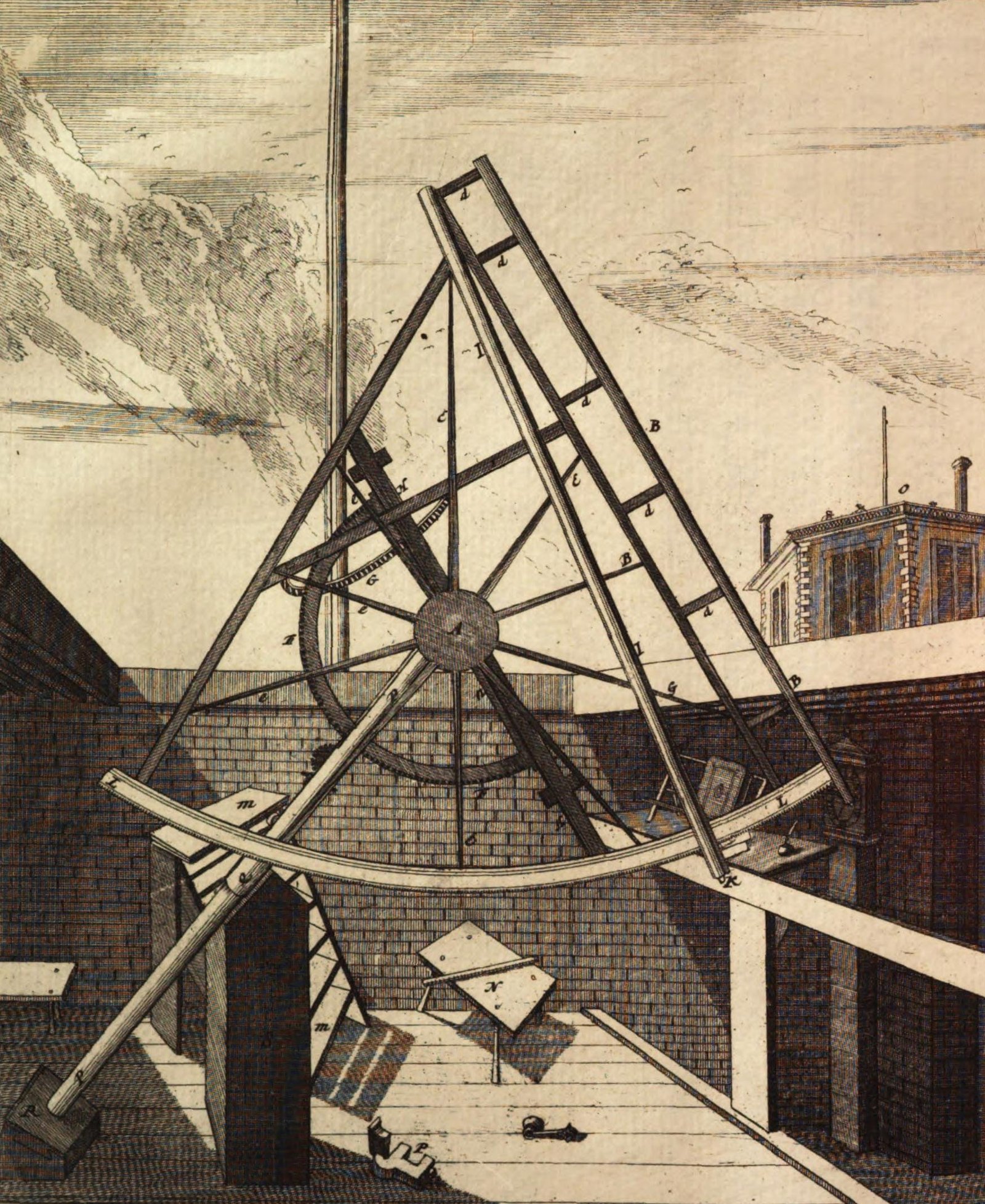
Flamsteed's Sextant House in about 1677. The Equatorial Sextant is in the centre. The Sextant House Clock is in the shadows on the right and Flamsteed House is in the background. Detail from an etching by Francis Place after Robert Thacker in Flamsteed's Historia Coelestis Britannica (1725). Reproduced courtesy of the MDZ (Münchener DigitalisierungsZentrum, Germany) under a No Copyright-Non Commercial-Use licence (see below)
The Octagon Room Clocks
Two year going clocks made by Tompion with 13-foot (four-metre) two-second pendulums (which are usually referred to as the Great Clocks, the Tompion Clocks or the Octagon Room Clocks) were delivered to the Octagon Room in the summer of 1676 (probably on 7 July). They were unusual not only because of the length of the pendulums, but also, because the pendulums were suspended above the dials. It is not known how long they took to install (which was not straight forward), but what we do know is that they were the only clocks in the Octagon Room by 14 September as that is the date that the first recorded observation was made in the Sextant House. The two clocks can be seen to the left of the door in the etching below. Although at first sight, they appear to be identical, a key difference was in the way the pendulums were suspended. The one closest to the window (marked A in the etching) was suspended from a spring whilst that nearest the door (marked B) was pivoted on a knife edge. Both were set to show mean solar time.
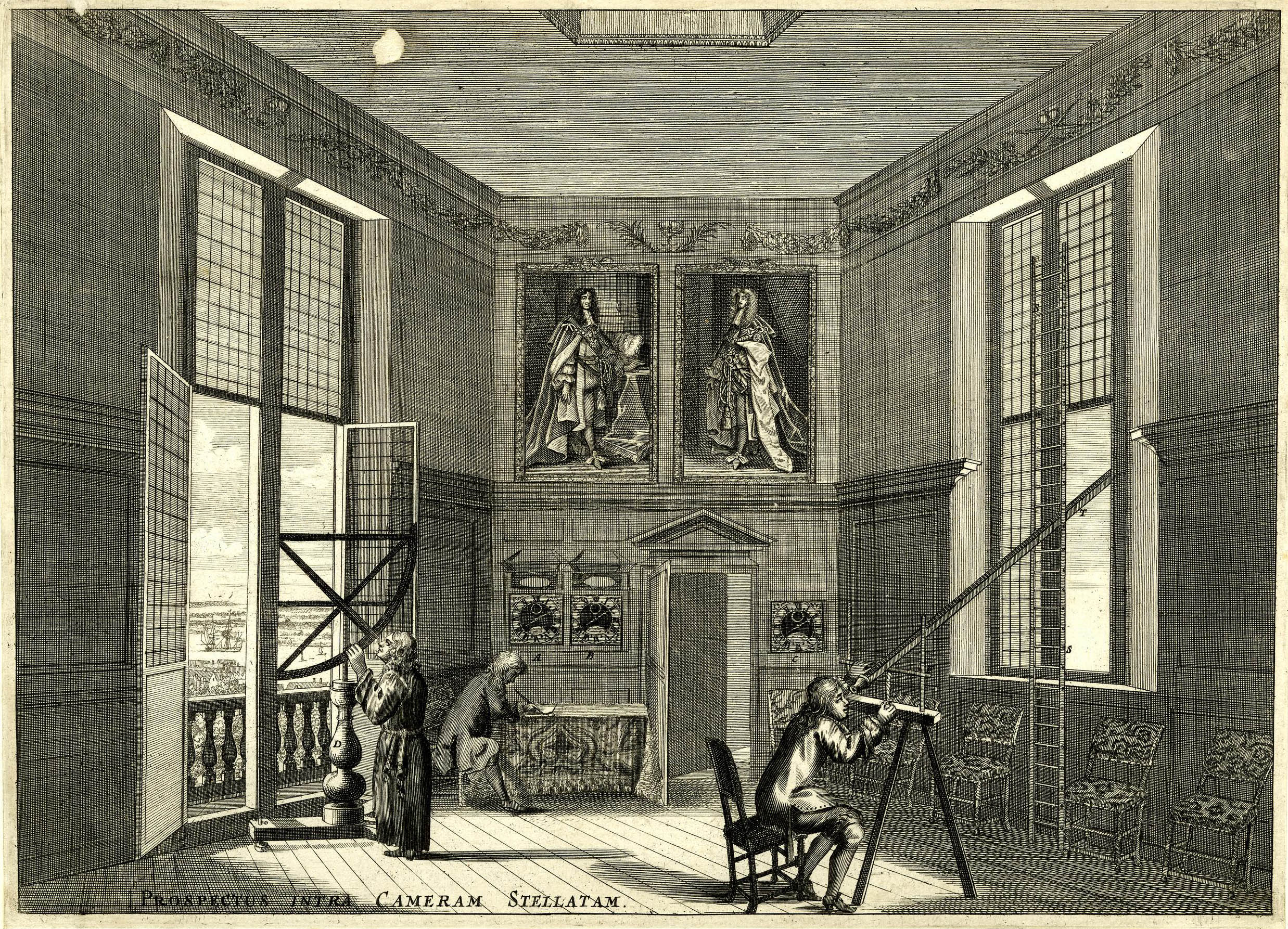
The Octagon Room in Flamsteed's time. Etching by Francis Place after Robert Thacker c.1677. © The Trustees of the British Museum (CC BY-NC-SA 4.0). Museum number: 1865,0610.952 (see below)
A third clock with a shorter pendulum of 72 7/10 inches beating 44 times a second was also planned for the room. Whether or not it ever materialised is the matter of some debate. There are no obvious records of it having been used in practice, but there is evidence to suggest that at the very least, preparations were made to install it in the position shown to the right of the door (more on this below).
The Arc House Clock
In 1690, Flamsteed bought a new clock for use with the Mural Arc which first came into use at the end of 1689 and was mounted in the former Quadrant House. From September 1689 until the arrival of the new clock on 31 October 1690, the Sextant House Clock was used instead. Like the Sextant House Clock it replaced, the new Clock had a seconds pendulum, but little else is known about it. It was probably made by Tompion.
The Octagon Room Clock from which timings were taken was sometimes referred to as the 'Horologium in Camera Superiore'. There are several references to it in both the observing books and the published observations during November and December 1689 when it was being compared with the Sextant House Clock while it was being used in the Arc House while the Mural Arc was undergoing calibration.
The Degree Clock
As well as the clocks already mentioned, Flamsteed had a clock made by Tompion in 1691 with a 2/3 second pendulum that was designed to show sidereal time in terms of degrees minutes and seconds rather than in terms of hours minutes and seconds. Now referred to as the Degree Clock, there appear to be virtually no manuscript records of it ever being used. There is certainly no mention of it in the Historia.
The portable clock
We also know that Flamsteed had a portable clock or horologium ambulatorium. No written description exists, but it does appear in one of the set of etchings of the Observatory produced in about 1677. There, it is shown in the eastern summerhouse where it may have been used to time solar eclipses. It was presumably also used when timings were required with one of the outside telescopes as well as for comparing the clocks in different parts of the Observatory.
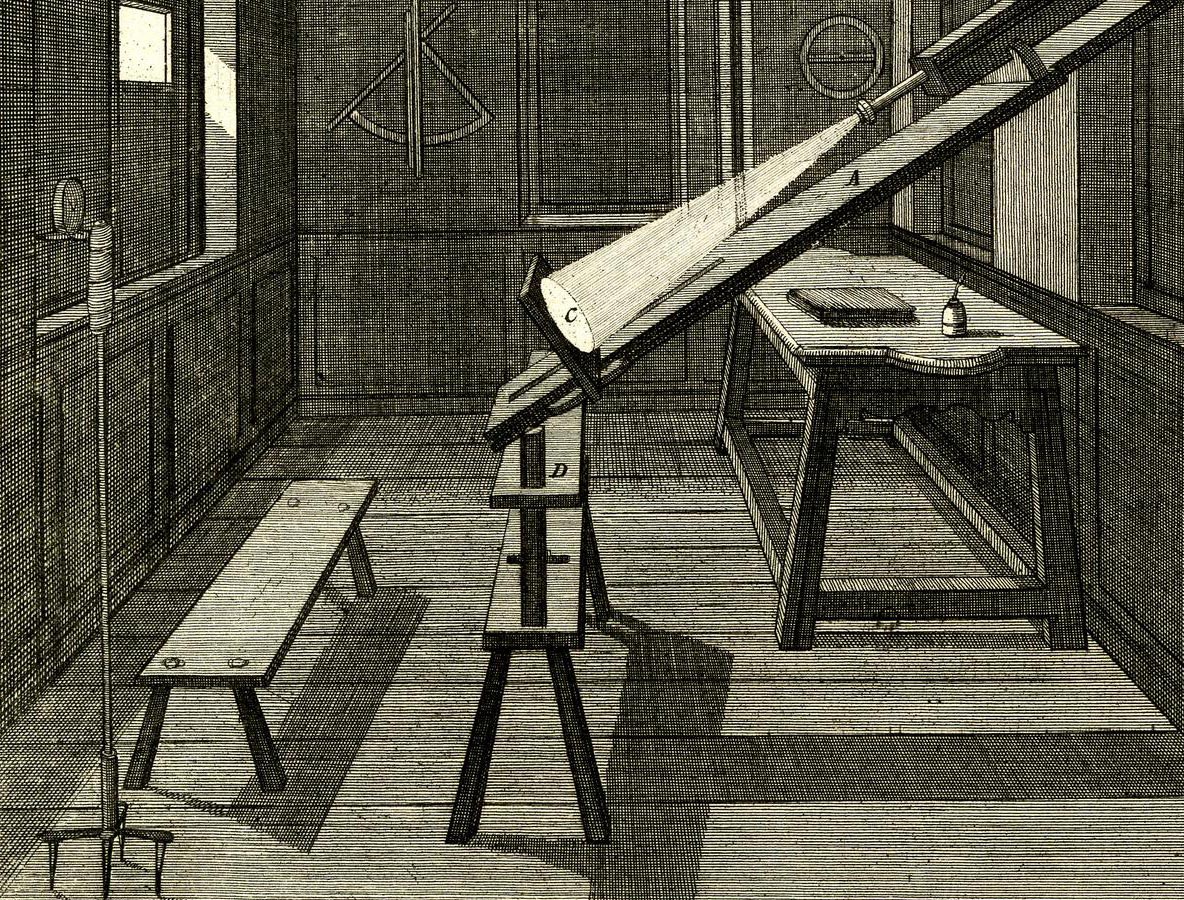
The horologium ambulatorium (left) in the Eastern Summerhouse where a projection of the Sun's disc (C) is being viewed. The image shows the movement in a circular enclosure mounted on a four legged stand which has a hand grip near the top allowing it to be easily picked up and transported. It was presumably spring driven. Detail from an etching by Francis Place after Robert Thacker c.1677. © The Trustees of the British Museum (CC BY-NC-SA 4.0). Museum number: 1865,0610.953 (see below)
There are sporadic references to the clock by name in the original observing books (RGO1/1–8) as well as a single entry in the Historia under the date of 16 February 1686. This states: 'Tempora notata fuere ab Horologio ambulatorio quibus propterea haud nimium fidas certa sunt ad minutum temporis vix proprius.' which translates roughly as 'The times were noted by an ambulatory clock, which, therefore, is not very reliable, being accurate to the minute of time.) The observations to which it refers were made in the Sextant House, the Sextant House Clock presumably being out of order. Despite what Flamsteed wrote, all the timings are given to the nearest 10 seconds rather than the nearest minute or half-minute.
The pocket watch
As well as the horologium ambulatorium, Flamsteed also mentions a pocket watch (which appears to have had both an hour and a minute hand) which he used while observing in May 1675 (RGO1/10/20). There is also a note in the observing book that the watch was used to time 17 of the observations made on 26 January 1682. The timing of one of these was given to the nearest half minute whilst the rest were given to the nearest minute only. All were subsequently published in the Historias, (most on p.65). Nothing is known about the watch's construction or when Flamsteed acquired it. Although there is no direct evidence, it seems entirely possible that he sometimes used it when comparing the Octagon Room and Sextant House Clocks (more on this below).
Surviving clocks
Of the seven clocks owned by Flamsteed, only three survive: the two great clocks (both of which have been modified from their original form) and the Degree Clock. There are no records of his watch surviving.
The publication of the two Historias
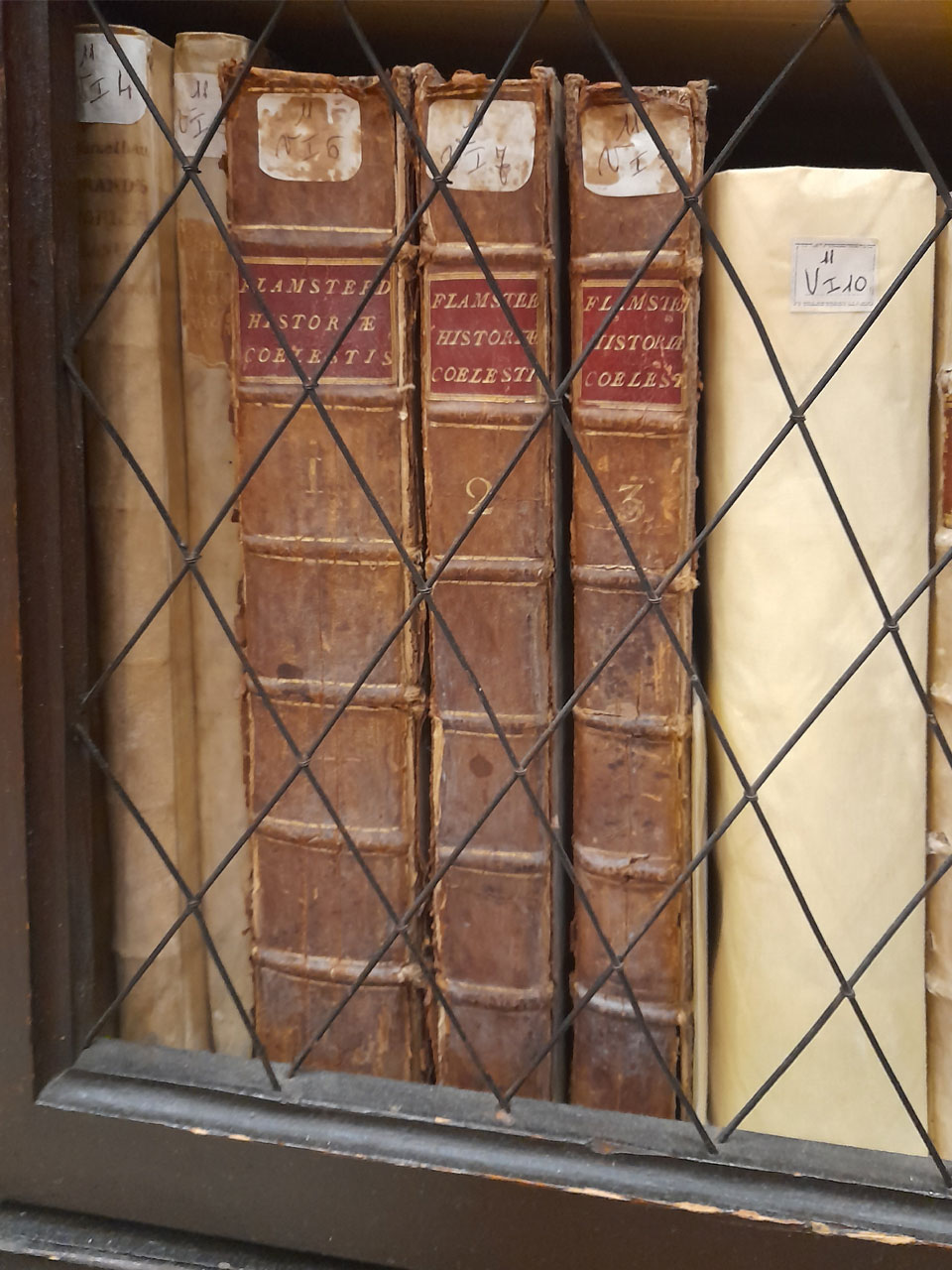
The three volumes of the 1725 edition housed at the University of Bologna, Italy. Photo: October 2023
The second edition was published posthumously in three volumes in 1725:
Historia Coelestis Britannica Volume 1
Historia Coelestis Britannica Volume 2
Historia Coelestis Britannica Volume 3
The pages extracted from the 1712 edition make up the bulk of Volume 1 which covers the years 1676-1689. The observations in Volume 2 cover the period 1689-1719. Volume 3, amongst other things, contains his star catalogue as well as a lengthy preface that runs to some 164 pages of text. This was originally intended to be rather longer, but following Flamsteed's death at the end of 1719, his widow and assistants decided that the section berating Newton and Halley should be suppressed.
The 1712 edition also had a preface, but this one was very much shorter and was written by Halley.
Some of the problems when trying to analyse the published observations is the lack of consistency in the layout, the numerous transcription and typographical errors errors and the use of unexplained phrases such as "reducto pondere" which appears over 180 times in Volume 2 of the 1725 edition and appears to be a reference to the index (alidade) of the mural arc rather than anything to do with the arc house clock.
Indeed, Halley ended the preface of the 1712 edition with this warning to its readers:
'Yet in view of the great bounty of the gift [i.e. the published volume], the odd blemish should not cause offence nor the fact that so many printing errors are found in the first book, hardly excused by the haste of the toiling press ...'
Although each of the two editions has an extensive errata, it is suspected that very few copies have had the offending pages corrected by their users. If anyone knows of copies that have, please contact the website though the link in the copyright notice in the footer at the bottom of the page.
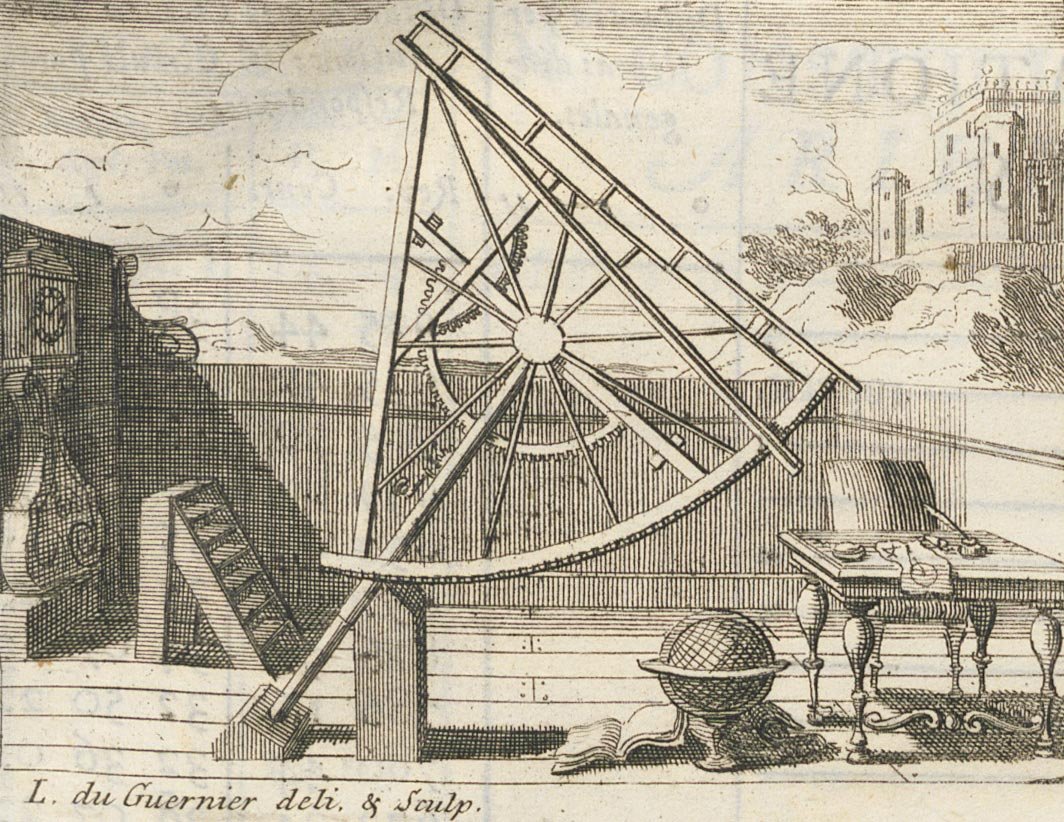
The left half of the headpiece showing the Equatorial Sextant and a clock in an elaborate case. Reproduced under a Creative Commons Attribution-ShareAlike 4.0 International (CC BY-SA 4.0) license courtesy ETH Zurich (see below)
The headpiece drawn by Du Guernier appears to be a crude reinterpretation of the Francis Place etching of the Sextant House in the previous section and shows the presence of an elaborate (and fanciful?) clock. Although it is thought that Flamsteed had no part in either the design or commissioning of the headpieces he did not disapprove of them sufficiently to stop him from recycling those pages containing them in his edition of 1725. Not only that, he also appears to have obtained at least two and possibly all five of the printing blocks, which he reused in Volumes 2 and 3 of the 1725 edition as well as in the Atlas Coelestis of 1729. Given that Flamsteed was all about accuracy and reducing and eliminating errors when it came to his observations, what does his reuse of the Sextant House headpiece with its spurious clock tell us not only about the way in which he regarded his clocks but also the image he wished to project?
Flamsteed's observing books
Rather than each location at the Observatory having its own observing book, all the observations were recorded chronologically into a single volume, new volumes being started as and when needed. Between them, they covered the period 1676–1719. Some of the observations and notes are recorded in English and some in Latin. Flamsteed gave the first of the volumes the title:
'Minutes or first notes of Observations being those made with the Sextant, from April 11, 1676, to Octobr 30 1679'
Not all of the observing books survive (there is no volume with the entries from 17 November 1702 to 2 January 1712 exclusive). The eight surviving volumes have the class marks RGO1/1–8.
On the whole, the titles vary from volume to volume. The third for example is titled: 'Libri Tertii observationum pars prior' ('First part of the third book of observations'). In his 1830s catalogue Baily described all eight as 'Minutes or first notes of Observations ... ', a form of words that continues largely unchanged today.
We know from Flamsteed's preface to the 1725 Historia that these First Night Notes (as he referred to his observing books)
'were wrote in 4to Volumes & from them were commonly transcribed correctly into large folios next morning from which the [later] Copies were taken.' (Newton Project RGO1/32C & Baily's Flamsteed, p.80).
Those observations made between 1689 & 1719 (RGO1/4–8) appear to have been transcribed into the volumes that now carry the classmarks RGO1/15–17 and are described by Flamsteed as 'Apographa' and in the current catalogue as 'exact copies'. That they are 'exact copies' is not entirely true as some data that is key to the present investigation was omitted (more on this later). Although he did not comment on this particular omission, when cataloguing the papers in the 1830s. Francis Baily did write:
'In the preceding volume [RGO1/15], and in the present one [RGO1/16] as far as the end of 1698, the zenith distances are copied from the originals with the correction of the instrument applied; which does not always accord with that which Flamsteed ultimately adopted. I would also remark that I have occasionally met with entries of observations which are not to be found in the original MSS: so that it will be necessary to examine these copies as well as the originals, in case of any revision of the observations.'
There is also at least one incidence of a whole day's observations being omitted. Those that took place on 24 July 1690 being an example. In this particular case it appears to be due to the clock having to be restarted before the day's observing began.
There is nothing in the archive catalogue to suggest that the earlier observations were copied in the same way. There is however a note near the end of the third observing book under 14 May 1689 that seems to begin 'omittanda in Apographa' (to be omitted in apographa). What may have happened is that the earlier observations were transcribed into a variety of different places depending on the type of observation that had been made. Further research is required to properly understand how RGO1/1–3 were processed.
The clock times in both the 1712 and 1725 Historias are given in terms of the astronomical day, with each day beginning and ending at midday (rather than the civil day which ran from midnight to midnight and started 12 hours earlier). It is important to note too that all Flamsteed's clocks (apart from the unsuccessful Degree Clock) were set to mean solar time rather than sidereal time. Despite the fact that the observations as published in the Historias were given based on the astronomical day, Flamsteed only started using astronomical time in the observing books when the mural arc came into use in 1689 (RGO1/4–8). The times recorded in Flamsteed's first three observing books (RGO1/1–3) are recorded in terms of the civil day using a 12 hour rather than 24 hour notation. Civil time was also the time system used for eclipse observations in Philosophical Transactions where some of Flamsteed's observations were also published.
Despite the fact that Flamsteed recorded astronomical times in the five surviving observing books used with the mural arc, there is an anomaly, at least to start with (and until at least 1693) about the way in which he recorded the times of the Sun's transit, Those observations that were made at the end of the astronomical day were recorded with the following day's observations but the time was given using a 12 hour nomenclature for example 11.55.46 on 18 April 1690. When transferred to the apographa this was recorded as A.M. 4.14, by which Flamsteed meant 4 minutes 14 seconds before 0h, 0', 0" astronomical time. In the published observations, it was recorded under 17 April as 23.55.46. Another anomaly (a one off?) can be found in the observing book (RGO1/4) where a number of observations made between 19.30 and 19.45 (astronomical time) on 16 June 1690 have been recorded in the observing book (but not the apographa or published observations) as being made on 17 June. A another example from 1693 is where the published observations made on 4 December (astronomical time) are recorded as having been made on that date in the apographa but during the morning of 5 December (civil time) in the Observing book.
There are also a number of anomalies in the published observations where both the civil date and the astronomical date are given. For example, the first two days worth of published observations are given as 1689, 'Sept.11 vel 12 mane' and 'Sept.12 vel 13 mane'. There are eight other occurrences, with the last one being on 1690 Feb 4 vel mane 5.
Although he recorded the time of each observation, Flamsteed did not record where in the Observatory the observation was made or the clock used. When he came to publish his observations, those from different locations remained lumped together in chronological order, again without any mention of clock or location. Although other factors mean that it is often possible to distinguish observations made in the Octagon Room from those made elsewhere this is not always possible. Nor is it possible to discern from which of the two Octagon Room clocks the recorded time was taken though this would not matter if Flamsteed always took the time from the same one. Flamsteed 'corrected' (i.e. deduced the errors) of the in the Octagon Room clock(s) from measurements of the altitude of the Sun or a selected star (more on this later). Similar observations of the Sun's altitude were also made during the commissioning of the Mural Arc and on a few later occasions. Although these probably took place in the Octagon Room, it's not impossible that they were taken in the arc house (more on these observations later).
The published observations and correspondence show that Flamsteed used a projection screen to view a solar eclipse on at least six occasions but there is no explicit record of whether these observations were made in the Octagon Room or in one of the Summer Houses. For more information on this see: Solar eclipses observed at Greenwich during the time of Flamsteed (1675–1719).
Amongst the observations in the published Historias are some made at the Observatory in 1678 by Edmond Halley that do not appear in the observing books such as the one he made on 27 July. However, in the observing books the the observations made on 23 July are immediately followed by those made on 2 August. None of the observations made between1 September and 14 October are there either, but there is a note dated 31 August 1678 that states (in Latin) that Flamsteed went to Derby for about a month, on account of a dangerous illness with which he was seized: and that during his absence Halley had made some observations which Flamsteed recorded were in another little book of a few pages; and for the insertion of which, blank pages were left in the observing book. Baily however was unable to 'discover either the little book, or the observations' though some appear on the pages of the Historia that follow those made on 27 July, whilst others appear elsewhere in the volume. There are also ones that were made with the Equatorial Sextant during August that do not appear in the observing book. It seems however these weren't the only occasions where entries are missing. Another example of missing observations are those of Jupiter's satellites that were made on 12 April 1684 (p.357). Further research is required to identify other omissions and what they might tell us about the way Flamsteed kept his records.
Evolving a house style and the use of standardised expressions
What is apparent from both the manuscript and the published observations is a lack of consistency in the way that data is presented. This not only makes it more difficult to carry out research, but more importantly, it makes it much more difficult to generalise with confidence. It would seem that although Flamsteed had a broad plan about the way his observations would appear in print, he had not fully thought though some of the details in order to have a plan that would provide for consistency from the start. Things were probably made worse by the fact that printing began before all the sheets had been prepared for the press which resulted in inconsistencies in the presentation and abbreviations used.
A further issue arises because some sheets were altered while the press was running, the result of which is that some pages vary slightly from copy to copy. No evidence has been found to suggest that these changes are anything but minor and don't appear to affect the meaning; but one practical consequence is that it can hamper the effectiveness of a word or phrase search which could easily lead to things being missed. The following examples have been identified in Volume 1 of the 1725 Historia.
- In some of the pages of some copies, 'err.' has been printed as 'err' without the full stop.
- On p.1, the spacing between the words Historiae and Coelestis in the heading is wider in some copies than others
- p.34 numbered as 43 in some copies
- p.131 numbered as 331 in some copies
- On pp.357 & 358, the heading at the top of the first column in some copies includes the extra words ‘Mense Die’ [day of the month]
- p.357 in one of eight copies inspected, the observation made on 3 January 1684 has been omitted and the text entered under 19 December spread over five lines rather than four and that on 15 June spread over two lines rather than just one. In addition an additional observation has been added under 20 December. (view page with 3 January entry) (without 3 January entry)
- p.385 in some copies numbered as 381
At this point, although not directly relevant here, it is worth noting that the printer of the 1712 edition did not use a consistent typeface for the long s.
From observing books to publication - the organisation of the observations
The first of the 1725 volumes contains observation made between 1676 and 1689 when the Equatorial Sextant was the main observing instrument. The second contains those made between 1689 and 1720 when with the Mural Arc was the main instrument. However, the way in which Flamsteed presents his observations changes between the two volumes. In Volume 2, the observations are published in the order that they appear in the observing books. In Volume 1, they are divided into six categories (which makes comparison with the observing books a lot more time consuming). They are numbered from two to seven.
No explanation is given for the change in presentation between the two volumes. Nor does Flamsteed explicitly explain how he rated his clocks or deduced their errors. Nor did he publish tables of their rate or error, though it is possible (though unlikely) that such tables exist and are waiting to be discovered in the archives.
Not all the manuscript observations appear in the printed Historias. One example of those omitted are the observations of Sirius made with with the Sirius Telescope in the late 1670s. Another example is the third set of observations of the Sun's altitude that he took for correcting the clock at the time of the solar eclipse of 1676 (the three sets of observations having been taken on 31 May and the 1 June). It should be noted here that there is also an unexplained discrepancy in these particular sets of altitude observations in the observing book and those subsequently published in the Historia and Philosophical Transactions, which also differ from one another. Other examples of observations of the sun's altitude being omitted from the Historia have also been found.
The column headings relating to time in the two Historias
The column headings in the two editions of the Historia
Latin term used |
Translation |
|
| 1 | Temp. App. / Temp. Ap. | Apparent time |
| 2 | Tempora per Horologium Oscillatorium/Tempora per Horolog. Oscillat. | Time by the pendulum clock |
| 3 | Tempora ex Altitud. Correcta | Times corrected by altitude(s) |
| 4 | Tempora ab Observationibus Correcta | Times corrected by observations |
| 5 | Tempora Correcta | Corrected times |
| 6 | Tempora (inde) ab Observationibus Correcta | Times corrected (from) observations |
| 7 | Tempora vera Apparentia | True apparent times |
| 8 | Tempora vera & correcta | The true and correct time |
| 9 | Tempora juxta Horolog. Oscillatorium | Times according to the pendulum clock |
| 10 | Transituum tempora per horologium Oscillatorium | Time of transit by the pendulum clock |
The grouping of observations and the times as published in volumes 1 & 2 of the
1725 Historia and books 1 & 2 of the 1712 Historia
Section from 1712 book 1 & 1725 Vol.1 |
Times given |
||
| 2 | Distances of fixed stars taken with the sextant (1676–1689)4 | Temp. App.1 |
|
| 3 | Observations of comets & primary planets made with the sextant (1676–1689)5 | Temp. App.1 | |
| 4 | Observations of the Moon's approach to fixed stars made with the sextant and other instruments (1676–1689)6 | Tempora per Horologium Oscillatorium & Tempora ex Altitud. Correcta |
|
| 5 | Observations of the configurations & eclipses of the Jovian comets (1676–1689) | Tempora per Horologium Oscillatorium & Tempora ab Observationibus Correcta |
|
| 6 | Observations of sunspots (1676–1689) | Tempora Correcta | |
| 7 | Observations of altitudes & distances of the sun from the vertical quadrants and the distances of Venus from the sun made with the sextant for investigating celestial refraction (1678–1681) | Tempora per Horologium Oscillatorium & Tempora (inde) ab Observationibus Correcta2 |
|
Sections from Book 2 (1712 edition) |
|||
| 1 | Observations of the primary planets made with the Mural Arc (1689-1705) | Tempora juxta Horolog. Oscillatorium2 & Transituum tempora per horologium Oscillatorium & Tempora vera & correcta1 |
|
| 2 | Observations made of the Sun and Moon with the Mural Arc (1689-1705) | Tempora per Horolog.Oscillat. Tempora juxta Horolog. Oscillatorium & Tempora vera & correcta |
|
| 3 | Observations of eclipses of Jupiter (1689-1705 [1702]) | Tempora juxta Horolog. Oscillatorium & Tempora vera & correcta |
|
Sections from Vol 2 (1725 edition) |
|||
| 1 | Observations of the fixed stars & planets (and the moon and sun) made with the Mural Arc and other instruments (1689–1720 [1719]) | Tempora per Horologium Oscillatorium & Tempora vera Apparentia & Tempora vera & correcta3 |
- Times given to nearest minute only.
- Only applies to some observations.
- This heading was used in the second column on pages 3-36 (out of a total of 573), the remainder being headed Tempora vera Apparentia. Those on pages 1-2 in the published observations were labeled Tempora vera & correcta or Tempora correcta in the apographa. They were the last in the first volume of the apographa (RGO1/15) to have the headings written in. The headings in the second volume were also left blank (RGO1/16). However, those in the third volume of the apograph are marked 'Tempora Correct(a). There is no mention of anything about the headings being wrong in the erata. Further research is required to establish which heading(s) are correct. To do this 'accurately' requires the tables for the equation of time that were originally used to be identified. In a letter to Newton dated 18 January 1695 Flamsteed stated 'The Tables in Parkers allmanack are those I have hitherto used'. These would appear to have been published as Mercuriouse Anglicannus between 1690 to 1698 and An Ephemeris of the Coelestiall Motions from 1695 to 1699 and a Double Ephemeris from 1700. In Volume 1, the Times associated with the Observations of the configurations & eclipses of the Jovian comets are given as Tempora per Horologium Oscillatorium & Tempora ab Observationibus Correcta, whereas here, they are all supposedly given as Tempora per Horologium Oscillatorium & Tempora vera Apparentia. If apparent times rather than corrected clock times are being given, then an explanation for the change in approach is required. RGO1/47 contains manuscript tables for the equation of time for the years 1700, 1701 & 1702. Their origin and who compiled them is unknown.
- The distances of the fixed stars are further rearranged in chronological order by constellation.
- The observations of Comets and primary planets are also arranged chronologically in the following order: comets, Saturn, Jupiter, Mars, Venus, Mercury.
- Includes observations made from the Queen's House from 11 February 1676 onwards.
The enigma of the Octogon Room Clocks by Tompion
in 1673 in his book Horologium Oscillatorium, Huygens wrote how two identical pendulum clocks weakly coupled through a heavy beam, soon synchronized with the same period and amplitude but with the two pendula swinging in opposite directions. Given that the pendulums of the two Great Clocks in the Octagon Room were the same length and attached to the same wooden beam, it is important to establish whether they too became syncronised.
The Historias themselves provide no answers, but there are some clues in the observing books and amongst Flamsteed's correspondence. By using these, Howse compiled a table to illustrate the performance of the two clocks between their arrival in July 1676 and February 1678 which he included in his Antiquarian Horology article. Useful as it is, it is not only incomplete, it also fails to give the wider picture which is unfortunate.
Tables showing the difference in time between the two clocks are few and far between, but there are partial tables at the end of RGO1/1 and RGO1/2 covering some dates in 1676 and 1677.
Figures from a poorly laid out table spread over RGO1/1/200-202 were included (with others) in Flamsteed's letter to Towneley dated 11 December 1676. In that letter, Flamsteed gave the difference in time shown by the two clocks on a roughly daily basis between 20 October and 8 December as well as the absolute error of the Spring Pendulum Clock obtained from altitude observations on six of those dates. Of these, only those from 13 November to 2 December can clearly be identified as coming from the end of RGO1/1.
What is quite clear from these and later figures is that the clocks did not become syncronised and showed no sign of doing so. The following table is based on Flamsteed's letter:
| Pivot | slower | Pivot | slower | Pivot | slower | |
| 1676 | m s | m s | m s | |||
| 20 Oct | 0. 06 | 17 | 0. 52 | 1 Dec | 0. 06 | |
| 21 | 0. 10 | 19 | 0. 46 | 2 | 0. 00 | |
| 22 | 0. 12 | 20 | 0. 40 [0. 46]a | Pivot | swifter | |
| 25 | 0. 20 | 22 | 0. 44 | 3 | 0. 04 | |
| 29 | 0. 28 | 23 | 0. 44 | 4 | 0. 06 | |
| 31 | 0. 38 | 24 | 0. 44 | 5 | 0. 22 | |
| 4 Nov | 0. 30 | 25 | 0. 44 | 6 | 0. 40 | |
| 6 | 0. 36 | 26 | 0. 46 | 7 | 0. 50 | |
| 13 | 0. 52 | 27 | 0. 45 | 8 | 1. 00 | |
| 14 | 0. 52 | 28 | 0. 34 | |||
| 15 | 0. 52 | 29 | 0. 30 | a. mis- | ||
| 16 | 0. 52 | 30 | 0. 18 | transcribed |
In the letter Flamsteed explained that although during this period, altitude observation had been taken on 22, 25 & 29 October, 5, 16, 17, 23 & 27 November and 3, 5 & 8 December (Civil dates?), at the time of writing he had only reduced those made on 22 October, 5, 16, 17 & 27 November and 5 December. During this period, the only altitude observations that were published in the Historia were made on 30 October, 10 November and 2 & 5 December (astronomical dates). These are also the only dates where altitude observations are recorded chronologically amongst the observations in the observing book. Surprisingly, the 10 November altitude measurements are not amongst those mentioned by Flamsteed in the letter. So where are the rest of the altitude observations recorded? The answer seems to be scattered throughout the table at the end of RGO1/1 where six sets of observations can be clearly identified.
What is also odd is that the published figures for 5 December are at odds with those in the observing book in that although the altitude observations appear to correspond, the clock times and the clock errors recorded are all 50 seconds less than those that were published, suggesting that the recorded time may have come from one clock and the published time from the other, though there is no record of the difference in the clock times in the observing book. Nor can the figure of 50 seconds be reconciled with what Flamsteed recorded in his letter where he states the difference between the two clocks as 6, 22, 40, 50 and 60 seconds on 4, 5, 6, 7 and 8 December respectively.
The table Flamsteed compiled in 1677 that can be found on f. RGO1/1/198 shows the difference between the two clocks between 16 March and 27 November 1677. Entries are sparse until 4 July after which there is an entry for most days until the start of November apart from a week's gap in October. (table under construction)
| Month | Mar | Apr | May | Jun | Jul | Aug | Sep | Oct | Nov |
| ' " | ' " | ' " | ' " | ' " | ' " | ' " | ' " | ' " | |
| 1 | +0.18 | +0.22 | - 1.38 | +0.15a | - 0.38 | ||||
| 2 | +0.20 | +0.20 | - 1.50 | +0.14a | - 0.39 | ||||
| 3 | +0.22 | +0.18 | - 2.02 | +0.14a | Note c | ||||
| 4 | +0.23 | +0.46 | +0.16 | Note b | - 0.13 | ||||
| 5 | +0.25 | +0.14 | - 0.02 | - 0.12 | |||||
| 6 | +0.12 | - 0.04 | - 0.12 | ||||||
| 7 | +0.45 | +0.11 | - 0.13 | ||||||
| 8 | +0.44 | +0.10 | - 0.07 | ||||||
| 9 | +0.09 | - 0.10 | |||||||
| 10 | +0.45 | +0.08 | - 0.12 | ||||||
| 11 | +0.45 | +0.06 | - 0.14 | ||||||
| 12 | +0.43 | +0.03 | - 0.15 | ||||||
| 13 | +0.41 | - 0.01 | - 0.17 | ||||||
| 14 | +0.40 | - 0.04 | - 0.21 | ||||||
| 15 | +0.37 | - 0.06 | - 0.19 | +0.20a | |||||
| 16 | +0.02 | +0.34 | - 0.07 | - 0.21 | |||||
| 17 | +0.34 | - 0.09 | - 0.21 | - 0.22 | |||||
| 18 | +0.33 | - 0.10 | - 0.24 | ||||||
| 19 | +0.33 | - 0.10 | - 0.23 | - 0.25 | |||||
| 20 | +0.37 | +0.32 | - 0.12 | - 0.25 | - 0.27 | ||||
| 21 | +0.32 | - 0.14 | - 0.26 | - 0.30 | |||||
| 22 | +0.37 | +0.31 | - 0.18 | - 0.25 | - 0.31 | 0.00d | |||
| 23 | +0.04 | +0.32 | - 0.21 | - 0.24 | - 0.32 | 0.02d | |||
| 24 | +0.30 | - 0.26 | - 0.23 | - 0.32 | 0.03d | ||||
| 25 | +0.29 | - 0.34 | - 0.21 | - 0.33 | 0.00 | ||||
| 26 | +0.02 | +0.28 | - 0.44 | - 0.20 | - 0.34 | ||||
| 27 | +0.42 | +0.28 | - 0.51 | - 0.19 | - 0.35 | - 0.08 | |||
| 28 | +0.44 | +0.27 | - 1.01 | - 0.18 | - 0.36 | Note e | |||
| 29 | +0.26 | - 1.08 | - 0.17 | - 0.36 | |||||
| 30 | +0.25 | - 1.12 | - 0.16 | - 0.37 | |||||
| 31 | +0.24 | - 1.26 | - 0.15f | - 0.38 |
a) Appears to have been recorded as + in error
b) Pivot clock stopped, wanted oil
c) Spring clock stopped, not restarted until 22 November
d) Sign not recorded
e) Spring clock stopped and pallets and scape wheel removed for modification
f) Seemingly entered in error, but not deleted.
The next table (below) dates from just over four years later and has been adapted from one at the end of RGO1/2 (RGO1/2/167).
1682 Jan.17. Clocks both cleaned & set together at 9h.00' then:
| Date | Spring pendulum (window) | Pivot pendulum (door) | Difference (S) | |
| h m s | h m s | |||
| 17 Jan 1682 | 9. 00. 00 | 9. 00. 02 | + 02 | |
| 18 Jan | 6. 25. 36 | 6. 25. 32 | - 04 | |
| 21 Jan | 10. 21. 14 | 10. 21. 00 | - 14 | |
| 24 Jan | 9. 07. 01 | 9. 07. 00 | - 01 | |
| 26 Jan | 6. 46. 00 | 6. 46. 07 | + 07 | |
| 28 Jan | 10. 03. man. | 10. 03. 09 | + 09 | |
| 30 Jan | 11. 24. man. | 11. 24. 08 | + 08 | |
| 31 Jan | 8. 24. m. | 8. 24. 07 | + 07 | |
| 5 Feb | 11. 40. 50 | 11. 40. 00 | - 50 | |
| 10 Feb | 3. 50. 04 | 3. 48. 15 | -109 |
Clearly by 10 February one or other or possibly both clocks must have been behaving very erratically. There is nothing in the observing book or Historia to indicate any intervention in the four weeks or so that followed, so the reason for the change in rate remains unknown.
The Horologium Axiculare enigma.
On p.241 of Volume 1 ot the Historia under the date 17 March 1679, the following words are printed:
'N.B. Quod in omnibus hucusque Observationibus in Obfervatorio habitis, Tempora per Horologium Axiculare numerata fuerint: In Sequentibus Laminari utar.'
It is the only reference to the 'Horologium Axiculare' in the several volumes of the Historia. Translation is proving tricky:
'N.B.That in all the Observations hitherto made in the Observatory, the Times have been numbered by the Axillary Clock: In the Following I will use the Laminar.' (Google translate)
But what does this mean? What exactly is the Horolgium Axiculare and what did Flamsteed mean by hitherto? In the observing book (RGO1/1) there is no mention of the clock around this time, but on 19 May 1679 there are entries (in Latin) in which the word Laminar appears twice, one of which appears to say ' Horologÿ Laminar. Horologÿ Axiculare is mentioned on 27 March 1679 and on 23 Feb 1681.
The phrase Horologio axinclari?? appears in the apographa (RGO1/14/2) under the date of 25 March 1679 and seems to include a phrase that translates as from 1 January (transcription (difficult) and translation in progress). Meanwhile, the wording (in Latin) in RGO1/20/39 is very similar to that published in the Historia, but there are spelling differences.
Later on p.251 of the Historia immediately after the date of 11 August (1679), Flamsteed wrote: Die sequente retraxi Indicem minutorum 40', quem à Kalendis Januarii raecedentis, nunquàm attigeram, nèc mutaveram (The following day I took back the Index of Minutes 40', which I had never touched or changed since the first day of the month of January preceding.) There is no entry for 1 Jan in the Historia, but in the observing book Flamsteed has recorded: that there was a 20' adjustment and that he altered the length of the pendulum by 2/3 of a revolution (RGO1/1/137).
When Flamsteed was working in the Octagon Room, he did not record the time from both clocks in the observing book when an observation was made. So how do we know which clock the recorded clock times were taken from? At the moment, the answer seems we don't. It is probable that in the long run at least, they were always taken from the same clock ... but if so, then what happened if that clock was temporarily out of use and how and where was this information recorded as we know that the two clocks performed differently. Perhaps it was to one of these two clocks that the phrase "Horologium Axiculare' referred.
Determining the true time from observations of the altitude of the sun and other stars, 1676–1689
Until 3 September 1689, Flamsteed found the error of the clocks in the Octagon Room by measuring the altitude of either the Sun or one of a number of stars that he had earlier selected for the purpose. When making such an observation, Flamsteed would typically take three to five readings (sometimes more) over a period of about five minutes (or so). As far as can be ascertained, all such measurements were made in the Octagon Room with the help of a small quadrant, and published with the Lunar observations in Volume 1 of the 1725 Historia. It is important to note:
- they appear only in the Lunar section which covers the period 11 February 1676 and 3 September 1689
- not all the sets of observations were published
It is clearly helpful to have a feel for how frequently Flamsteed checked the clock. The table below gives the number of sets of altitude observations published in each year. It is lower than the actual number of sets recorded in the observing books. The figures given in brackets for the years 1684 & 1689 are the actual number of sets that were made. They should not be extrapolated for other years. Further study is required to establish both the number taken each year and why particular sets were excluded from publication.
Year |
Sets published |
Year |
Sets published |
|
| 1676a | 27 | 1683 | 30 | |
| 1677 | 27c | 1684 | 26c,f (at least 50 sets in obs. book) | |
| 1678 | 19d | 1685 | 15g | |
| 1679 | 36 | 1686 | 18 | |
| 1680 | 52e | 1687 | 15h | |
| 1681 | 36c | 1688 | 9j | |
| 1682 | 46 | 1689b | 10k (30 sets in obs. book) | |
| a: 11 Feb - 31 Dec | b: 1 Jan - 3 Sep | |||
| c: one set not reduced | d: two sets not reduced | |||
| e: four sets not reduced | f: last set dated 19 Oct | |||
| g: first set dated 27 mar | h: last set dated 9 Sep | |||
| j : last set Sep 29 & first set missing altitudes |
k: refers to a set in Aug that was not published (see below) |
Flamsteed was well aware that his altitude observations were affected by refraction and discussed the problem with various people including Towneley and Newton who on 17 November 1694 sent him a refraction table with different values computed for summer, spring/autumn and winter. Flamsteed never took seasonal temperature variations into account in his tables, but when he wanted more certainty in his time determinations, he took sets of observations before and after noon when the sun was at the same altitude, presumably because he supposed that the amount of refraction would be the same. These are now referred to as equal altitude observations and, because Flamsteed was using astronomical time the two sets of observations appear under two dates rather than one in the Historia. Sometimes Flamsteed took equal altitude observations that were 24 hours or more apart. Other times, a single set of observations seems to have sufficed. What cannot be known is how often the second of a planned pair of equal altitude observations was lost because of the weather. One important thing to note about Flamsteed's equal altitude observations is that although the morning and afternoon altitudes were almost the same, in practice they were very rarely exactly the same. It should also be noted that Flamsteed was only able to use this method because he had previously determined the Observatory's latitude, and if a star rather than the Sun was being used, the declination of the star as well.
In his writings, Flamsteed briefly described the instruments that he used to measure the altitudes. The following transcript was made and published by Baily and is thought to be taken from RGO1/41 (but this requires checking).
'My pendulum clocks were the work of Mr. Tompion: the pendulums,13 feet long, make each single vibration in two seconds of time; and their weights need only to be drawn up once in twelve months. For rectifying these, I had provided a quadrant of about 3 feet radius, which I brought with me from Derby. It was no very good contrivance; but with it, however, I could take the sun's or a star's height so exactly that the differences betwixt the errors of the clock, collected from 4, 5, and sometimes 6 several heights of the sun or a star, was scarcely more than 10"; but commonly much less. This quadrant I employed till June, 1678; when, Sir Jonas Moore having procured me a neater that belonged to the Royal Society, I divided and employed it till October, 1679, when the ill-nature of Mr. Hook forced it out of my hands. Yet I lost nothing by it; for it was so ill contrived by him that I could not make it perform better than my first. And now he obliged me to think of fitting up one of my own, of 50 inches radius [the 50-inch Voluble Quadrant], wherein by peculiar contrivances I had avoided all the inconveniences I had met with in his. This gives an observed height to half a minute: and now, by it, I am sure of the observed times to three seconds; which I could not have expected from either of my other instruments.'
In 1678, Flamsteed stopped using the term altitude when recording the observations for correcting the clock and started using the term 'Dist. a Vert.' instead. The last published set to use the term 'Altitud.' was made on 22 February and the first to use Dist. a Vert. on 16 June. We know from the above, an the entry dated 16 June in the Historia and from a letter to Towneley dated 4 July 1678 that it coincided with a switch of instruments (Post mediam noctem sequentem vel 17 mane, secundum vulgi computum, Quadrante novo, Regia Societatis à mepo dispunctuo, ad investigandum Horologii Errorem frequentes captae a Vertice Distantiae). The first published observation made with the 50-inch Voluble Quadrant was made on 20 October 1679. A record of the switch can be found in the Historia where in the middle of the day's observations the following appears: 'Quadrante deindè proprio pedum plus quam 4 Radio, diftantiae à Vertice obfervatae.' which roughly translates to 'Then, in the proper quadrant, the radius is more than 4 feet, the distances from the vertex are observed.' An examination of the entries in the Historia indicates that when using the first two quadrants, Flamsteed was able to measure to the nearest minute of arc. With the Voluble Quadrant, he was able to measure to the nearest 10 seconds.
When the published figures are compared with those in the observing books, there are discrepancies. The four dates mentioned immediately below were sampled fairly at random from the earlier observations.The published figures for 5 May 1676 differ from those in the observing book as do those for 31 May and 1 June 1776 and 28 January 1677, where some sort of correction for refraction appears to have been applied to the published figures of altitude though the corrections applied do not seem to tally with those he published in a set of refraction tables (more on these below). The published observations for 28 January 1677 are all 6" of arc lower than those initially recorded in the observing book (RGO1/1), though the clock error is the same (on this occasion, the 6" correction also appears in the observing book). This is in contrast to the observing book record for 1 June 1776 (RGO1/1) where neither the altitude, corrected times or clock errors agree with what was later published.
Moving on to a randomly selected later observation made on 16 June 1684, we find much the same discrepancies between the observing book and the published observations with the published Dist. a Vert. figures differing (RGO1/3) but with the figures for the clock errors agreeing (RGO1/3).
Over a period of several years there is a mismatch between the altitudes / zenith distances recorded in the observing book and those subsequently published. The following from 23 January 1681 is an example. It should be noted that the figures given in the table Flamsteed published for the amount of refraction at different zenith distances are 1'31" for a ZD of 62o and 1'27" for a ZD of 61o, which suggests that the mismatch is not a result of a correction for refraction being applied. Nor is it clear why there are two entries in the observing book for each of the four sets of observations.
Lucidae in Juba Leonis |
23 Jan |
1681 |
||
Published |
Obs. Book |
|||
| 1 | Clock time | 8h06'10" | 8h06'10" | |
| Zenith Dist | 62o21'50" | [+2'40"] |
62o20'40" 62o23'20" |
|
| Corrected time | 8h04'41" | 8h04'41" | ||
| Error of clock | -1'29 | +1'29 | ||
| 2 | Clock time | 8h08'24" | 8h08'24" | |
| Zenith Dist | 62o00'50" | [+2'40"] |
61o59'40" 62o02'20" |
|
| Corrected time | 8h06'56" | 8h06'56" | ||
| Error of clock | -1'28" | +1'28" | ||
| 3 | Clock time | 8h10'30" | 8h10'30" | |
| Zenith Dist | 61o41'30" | [+2'40"] |
61o40'20" 61o43'00" |
|
| Corrected time | 8h09'00" | 8h09'00" | ||
| Error of clock | -1'30" | +1'30" | ||
| 4 | Clock time | 8h13'06" | 8h13'06" | |
| Zenith Dist | 61o17'10" | [+2'40"] |
61o16'00" 61o18'40" |
|
| Corrected time | 8h11'35" | 8h11'35" | ||
| Error of clock | -1'31" | +1'31" |
In the table above, all the published zenith distances are all 1'10" higher than the first of each pair in the observing book which themselves are all 2'40" less than the second.
So how does this compare with other sets? Selecting some at random, the same pattern occurs for the observations made on 13 Feb 1688. However on 25 Nov 1685, although the published zenith distances are all 1'10" higher than the first recorded observation, the second entry in the observing book is only 2'30" higher. The figures for the set of three measurement made on 5 Oct 1684 are 1'10" and 2'24, 2'23" and 2'22".
Going back further in time to 27 November 1680 we find that the published ZD is 1'10" higher, whilst the second figure in the observing book is and 2'30" higher. The ZD figure is still 1'10" higher on 1 June and 30 April 1680, but 1'20" higher on 12 April. The figures for 17 April were not published, but in the observing book there is a semi-legible note containing the figures 2'20" and 1'20" (RGO1/2/31). The ZD figure is 2'20" higher on 28 March 1680, but the second figure in the observing book is 12'10" lower. The figures for 28 March 1680 are reproduced in the table below. Although six sets of observation were made, only the first five were published, the last with a typographical printing error in the observed time.
Limbi Solis inferioris |
28 Mar |
1680 |
||
Published |
Obs. Book |
|||
| 1 | Clock time | 20h33'36" | 20h33'36"" | |
| Zenith Dist | 60o54'40" | [-12'10"] |
60o52'20" 60o40'10" |
|
| Corrected time | 20h35'12" | 20h35'12" | ||
| Error of clock | +1'36" | +1'36" | ||
| 2 | Clock time | 20h35'58" | 20h35'58" | |
| Zenith Dist | 60o35'00" | [-12'10"] |
60o32'40" 60o20'30" |
|
| Corrected time | 20h37'35" | 20h37'35" | ||
| Error of clock | +1'37" | +1'37" | ||
| 3 | Clock time | 20h38'10" | 20h38'10" | |
| Zenith Dist | 60o17'00" | [-12'10"] |
60o14'40" 60o02'30" |
|
| Corrected time | 20h39'46" | 20h39'46" | ||
| Error of clock | +1'36" | +1'36" | ||
| 4 | Clock time | 20h39'46" | 20h39'46" | |
| Zenith Dist | 60o04'00" | [-12'10"] |
60o01'40" 59o49'30" |
|
| Corrected time | 20h41'22" | 20h41'22" | ||
| Error of clock | +1'36" | +1'36" | ||
| 5 | Clock time | 20h43'35" [20h42'35"] | 20h42'35" | |
| Zenith Dist | 59o41'10" | [-12'10"] |
59o38'50" 59o26'40" |
|
| Corrected time | 20h44'10" | 20h44'10" | ||
| Error of clock | +1'35" | +1'35" | ||
| 6 | Clock time | Not published | 20h44'30" | |
| Zenith Dist | Not published | [-12'10"] |
59o23'10" 59o11'00" |
|
| Corrected time | Not published | 20h46'06" | ||
| Error of clock | Not published | +1'36" |
What is important to note, is that in all the examples given, the published figures for the clock time and the error of the clock are the same in the observing books
But moving forward to 15 Feb 1689, we find that that Flamsteed's recorded and published ZDs are the same, but the second figures given in the observing book is 1'10" more than the first. The last set to be published before 15 Feb 1689 appear on the previous page of the Historia and were taken on 29 Sep 1688. This time the published and recorded ZDs are the same, but the second figure in the observing book is 1'40" more than the first. However in the previous set of observations which are dated 14 Sep 1688 and contain five observations, the published and recorded ZDs are the same, but the second figures in the observing book 13'60", 13'23", 13'24", 13'29" & 13'22" lower than the first. The published ZD for 30 March 1688 is 1'10" greater than that the first figure in the observing book, whilst the second figure in each pair is 0'40" greater than the first. However, the top of the column in the observing book containing the second ZD figures is headed add 1'10" .
Arcturi |
30 Mar |
1688 |
||
Published |
Obs. Book |
|||
| 1 | Clock time | 10h24'26" | 10h24'26" | |
| Zenith Dist | 41o40'40" | [+0'40"] |
41o39'30" 41o40'10" |
|
| Corrected time | 10h18'40" | 10h18'40" | ||
| Error of clock | -5'46" | -5'46" | ||
| 2 | Clock time | 10h27'07" | 10h27'07" | |
| Zenith Dist | 41o20'20" | [+0'40"] |
41o19'10" 41o19'50" |
|
| Corrected time | 10h21'17" | 10h21'17" | ||
| Error of clock | -5'50" | -5'50" | ||
| 3 | Clock time | 10h29'38" | 10h29'38" | |
| Zenith Dist | 41o00'10" | [+0'40"] |
40o59'00" 40o59'40" |
|
| Corrected time | 10h23'54" | 10h23'54" | ||
| Error of clock | -5'44" | -5'38" [-5'44"] | ||
| 4 | Clock time | 10h32'09" | 10h32'09" | |
| Zenith Dist | 40o41'10" | [+0'40"] |
40o40'00" 40o40'40" |
|
| Corrected time | 10h26'24" | 10h26'24" | ||
| Error of clock | -5'45" | -5'45" | ||
| 5 | Clock time | 10h35'18" | 10h35'18" | |
| Zenith Dist | 40o18'30" | [+0.40] |
40o17'20" 40o18'00" |
|
| Corrected time | 10h29'24" | 10h29'24" | ||
| Error of clock | -5'54" | -5'54" |
It would seem therefore, that the published observations from some time around the middle of 1680 may have been corrected for a systematic error of 1'10". However, if this is the case, then the variations that seem to have occurred in 1688 need some sort of explanation.
Clearly, more sets of observations need to be compared if we are to get a full understanding of how Flamsteed processed this class of observation and any instrumental adjustments that he made.
There are several examples in Volume 1 of the 1725 Historia where Flamsteed has shown his workings to determine the rate of the clock. A search using the term 'error' will locate them. The table below shows his workings to determine the rate of the clock prior to observing a partial eclipse of the Sun on 3 September 1689. It appears on p.350 of Volume 1.
Latin text |
Translation |
||
| Die 27Augusti mane Horologii error erat + 3' 35" Sept. 3.00h p. m. + 6h 23' Ergo Diebus 6 2/3 retardaverat 2'46" & Quotidiè ferè 30" ut hora 4 fiet 6'27" ♂ Septembris 3. Eclipsis Solis coelo valde sereno Obfervavi |
On the morning of August 27th the clock was + 3' 35" Sept. 3.00h p. m. + 6h 23' Therefore, on the 6 2/3 rd day, it had slowed down by 2' 46" & every day by about 30" so that the 4th hour would be 6'27" Tuesday September 3rd I observed the eclipse of the Sun 30th in a very clear sky |
An examination of the volume however shows no time determining observations under the date 27 August 1689. Not only that, the last published set prior to 3 September are dated 10 June. From the reader's perspective, the text above is therefore not overly helpful as it is impossible to check the data on which it relies. However, an examination of Flamsteed's observing book (RGO1/3) reveals that he made measurements to determine the clock's error on 7, 13, 22 & 29 July and 16, 22 & 27 August. Why he chose not to publish any of them is not known.
Observations of Jupiter's Satellites 1676-1689
Although the lunar observations are accompanied by measurements of the altitude of the Sun or a star that were taken to measure the error of the clock, the observations of Jupiter's satellites have no such accompanying reference. Instead, the reader has either to take Flamsteed's word for what the clock error was or refer back to those altitude observations that Flamsteed chose to publish to accompany the lunar observations. How much more helpful it might have been if only Flamsteed had published a section of the Historia with just the altitude observations.
Having said that, the corrected times given by Flamsteed in the section on Jupiter's satellites does give us an easy way of seeing something of what was going on with the Octagon Room clocks and how the error fluctuated over time. The first published observation was made on 6 June 1677 when the error was -6'30". By 8 September 1677 it was -21'50". Just over a month later on 24 October it was -15'00" and a few weeks later on 13 November was -11'32". Moving on to 1682, we find that on 25 Nov it was just +20". On 3 January 1684 it was + 1h1'40", but a few days later on 8 January it was -3'38" suggesting that some adjustment had been made to the clock between those two dates. There is no record of such an alteration having been made at that time amongst the lunar observations. However in his observing book there is an entry between the set of observations dated the fourth of January and those dated the fifth, where Flamsteed records that he had put the clock back by 1h10', marking the entry with a pointing hand in the left-hand margin.
Recording adjustments made to the Octagon Room Clocks
By 1679/80, the Octagon Room clocks seem to have been adjusted so that in general they always had a gaining rate. Every now and again the hands would be put back. The smallest adjustment so far identified is 6 minutes and the largest 1hour & 10 minutes. Not every alteration to the clocks was published which makes those that were of limited value. This leads one to wonder about Flamsteed's own thinking not only about the importance of the clocks but also of how he thought his observations would be useful to his readers.
Those published in the Historia were generally recorded in italics from 1681 onwards. Nine of the entries contain the term 'reduxi'.
Date |
Entry in Historia vol.1 |
Translation (google) & notes |
page |
|||
| 1676, Sep 13 | Last possible date that the Sextant House Clock rather than the Tompion Clocks were used for timing Observations in the Octagon Room | |||||
| 1676, Sep 21 | Collatis his cum Obfervationibus diei 16, Horologium justo tardius incessisse compertum scrupulis 44 secundis quotidie, quo circa promovi minutorum indicem 10' unde provenit Horologii error in sequentibus Animadversionibus solummodo 2'20", quibus erat justo tardius. | Comparing these with the observations of the 16th, it was found that the clock ran just 44 seconds slower every day, about which I advanced the minute hand by about 10', from which comes the error of the clock in the following observations of only 2'20", in which it was just slower. | 209 | |||
| 1678, Jul 12 | Indices minutorum utriusq; Horologii promovi 6', & ad eosdem scrupulos composui, eo concilio ut tempora quam proximè media in posterum ostendant | I have advanced the minute hands of both clocks 6', and have composed them to the same scruples [set them to the same time], with the intention that they should show the times as nearly as possible in the future. [RGO1/1/123 states: 'July 12 at 9½ [illegible] of indeces of both put 6 minutes forward & set together'] | 230 | |||
| 1679, Nov 12? | Die sequente retraxi Indicem minutorum 40', quem à Kalendis Januarii prӕcedentis, nunquàm attigeram, nèc mutaveram. | The following day I withdrew the Index of Minutes 40', which I had never touched or changed since the first day of the month of January preceding. [There is no entry in the Historia for 1 Jan in the Historia, but in the observing book Flamsteed has recorded: that there was a 20' adjustment and that he altered the length of the pendulum by 2/3 of a revolution (RGO1/1/137)] | 251 | |||
| 1680, Feb 19 | Promovi indices horologium 30', & longitudines penulorum effeci aliquantulum breviores, observatae delindre distantia à Vertice. | I advanced the hands of the clock 30' and made the lengths of the pendulums somewhat shorter, and then observed the distance from the Vertex | 253 | |||
| 1680, Nov 23 | Reduxi Indices Horologiorum 24' deindè pro Errore investigando distantias a Vertice cepi. | I reduced the indices of the clocks to 24' and then took the distances from the vertex for the error. i.e, the hands were put back 24'. | 272 | |||
| 1681, May 23 | Hac die post Meridiem hora tertia ponderibus adimum descensis stetit Horologium | On this day, at three o'clock after noon, the clock stopped after the weights were removed from the ground.' The observing book states: 'Clock stood at 3 a clock after noon. was set with ye other at 7 | 278 | |||
| 1681, Jul 20 | Aequatio Dierum est 5' 49" quae subducta Errori Horologii manent. 12′ 50″. Reduxi Minutorum Indicem 13'. Unde fit Error Horologii in sequentibus hujus Vesperae Observatis 5' 40". | The equation of the days is 5' 49", which, after subtracting the error of the clock, remain 12' 50". I have reduced the index of the minutes to 13'. Hence the error of the clock in the following observations of this evening is 5' 40". | 280 | |||
| 1682, Jan 17 | Purgatis Horologiorum Rotulis Laminaris indices dispofui ut tempus aequale oftenderet, & alterius ad eadem momenta. Postridie pro ulteriore examinatione, distantiae à Vertice obfervatae. | Having cleaned the rolls [wheels] of the Laminar clocks, I arranged the pointers [hands] so that they would show equal time, and the other at the same moments. The next day, for further examination, the distances from the vertex were observed. [There is an entry in the observing book that states 'The clocks both taken down & cleaned after 17.' This is followed soon after by 'The Spring pendulum is almost 2 seconds [illegible] the pivot. times taken thereafter by the spring pendulum' which could imply that they may have previously been taken from the pivot one] | 287 | |||
| 1682, May 20 | Maij 20 Reduxi hujus Horologii indicem 9 min. deindè post Meridiem Distantias à Vertice obfervavi. | May 20 I reduced the index of this Clock to 9 minutes. Then after Noon I observed the Distances from the Vertex | 295 | |||
| 1682, Oct 21 | Hora 1½ p.m. promovi Indicem minutorum 16, ut Tempora quam proximè Aequalia exhiberet. | At 1½ p.m. I advanced the Index of Minutes to 16, so that it would show the Times as nearly Equal as possible.' [Compare with entry in observing book which is in Latin] | 301 | |||
| 1683, Jan 2 | Sequente Jovis 4 mane, Reduxi Indices horologiorum II', demisi perpendicula, ut tempora posthac tardiora aqualia propius oftenderent. | The following morning, Thursday 4, I reduced the indices of the clocks II', lowering the perpendiculars, so that henceforth slower times would be more closely aligned. [Also recorded in observing book and RGO1/20, though the form of words is different in both.] | 305 | |||
| 1683, Dec 3 | Die tertio Reduxi Indiculos in horolog. 40', quos à quarto Januarii præcedent. non attigeram; deindè | On the third day I put the hands of the clock 40', which have not been touched since the fourth of January | 317 | |||
| 1684, Feb 12 | Die Mercurii 13 Reduxi indices Horologii 6 Minuta1 | On Wednesday 13th, the clock's index was reduced by 6 minutes1 | 318 | |||
| 1684, Oct 8&9 | Octobris 8 & 9 purgatis horologiis utriusq; sinnul indices ad tempus quam proximè aquale; compofui deinde | October 8 & 9, having cleaned both clocks, I set the hands as nearly as possible to the same time [?1.52 p.m according to the observing book]2 | 328 | |||
| 1686, Mar 7 | Post Meridiem reduxi Indices 15' & demisi perpendicula, ſed vix vereor satis | This appears to be a reference to the Sextant rather than the clock | 335 | |||
| 1686, May 17 | Reduxi deinde à Ministro Indiculi 33' unde error Horologii factus 12'50" | The hands of the clock were put back 33' making the error 12'50" [having been just previously determined as 20'10"] | 336 | |||
| 1687, Mar 12 | Stetere Horologia propter Ventum Vehementissimum. | The clock stopped because of very strong wind. There is no entry under this date in the observing book (RGO1/3/51), but there is an entry for March 14 which states: 'Ye same day both clocks had stood it being a strong wind[.] clocks set together after [,] at 12h ' | 340 | |||
| 1689, May 15 | Deindre reduxi Indices 15' Facto Errore + 3'30" | The hands put back 15 minutes making the error + 3'30" [rather than 11'26" as determined a minute or two earlier] | 349 |
Notes:
1) In the satellite of Jupiter section (p.357), the clock error is recorded as being 1h1'40" fast on 3 Jan 1684. Five days later on 8 Jan it is recorded as being 3'38" behind suggesting a significant reset of the Octagon Room Clock(s) had taken place. There is no record of this amongst the lunar observations, but in the observing book (RGO1/2/162) a figure of 1h10' is mentioned on 4 (or possibly 5) January, the rest of the comment not being properly legible.
2) This was presumably done around midday and the clock reset with the help of his watch
Amongst the changes not published were those made on:
- hands put back by 30 minutes RGO1/2/71 on 13 Jan 1681, , but this info not published on p.273
- 30 May 1687, when the hands were put back 25 minutes
- 4/5 Jan 1684 (as mentioned above when the hands were altered by 1h10'.
The level of scrutiny of the observing books required to find all the records of adjustments made to the clocks is beyond the scope of this article and would be much facilitated by the records being digitised and made available on the Cambridge Digital Library.
Comparison of the Octagon Room and Sextant House Clocks
In Volume 1 of the 1725 Historia the words: 'Aufer utriusque temporibus 0'19" ' appear in the entry for 2 Oct 1685 (p.330). This translates roughly as 'subtract 19 seconds from both times [from these sextant observations]'. There is however no accompanying explanation as to why this was required.
However under the same date in the observing book Flamsteed has written:
19.28.00 Horologium Suprá
19.28.19 Horologium infrá
It would appear that 'horologium suprá' and 'horologium infrá' were alternative names that Flamsteed used for the Octagon Room Clock(s) and the Sextant House Clock. Taken together, the entries in the Historia and the Observing book indicate that not only was Flamsteed comparing the times shown on the clocks in the two locations, but he was also using a unified time scale. It should be noted however that there are no references to either the Horologium Suprá or the Horologium infrá in this volume of the Historia. Nor is there any other entry telling the reader to adjust the time in a similar way.
Although there are relatively few references in to the horologium suprá and horologium infrá in the observing books they are one of the few pieces of direct evidence that Flamsteed was using a unified time-scale with all the published times of observations made at the Observatory prior to the introduction of the Mural Arc being given in terms of the Octagon Room Clocks.
As we have already seen, Flamsteed did not have rigid standardised ways of recording things. In the observing book under the date 23 Feb 1684 after making observations of the angular distance between Jupiter and Regulo with the Sextant he has written: Tempora horologium hoc praeibat sdhinin Camera suproma 3'36" which roughly translates as 'the clock was running ahead of the camera above [ie the Octagon Room clock][by] 3'36". The figures in the observing book are difficult to reconcile with those that were published on p.142) of the Historia, as Flamsteed does not include the raw data as the pubished times are not the clock times but apparent times.
17 Apr 1684 adjustment to pendulum as well in observing book only 'horologium hoc tempora 47 secunda tardid ra longiori Pendulo numerabat' ('This clock counted the time 47 seconds slower than the longer pendulum') seems to be a reference to a comparison between the Octagon Room and sextant house clocks.
1686, feb16: On p333 of the Historia, Flamsteed has written: 'Tempora notata fuere ab Horologio ambulatorio quibus propterea haud nimium fidas certa sunt ad minutum temporis vix proprius,' (The times were noted by an ambulatory clock, which, therefore, is not very reliable, being accurate to the minute of time.) The Sextant house clock was presumably out of order. The times are given to the nearest 10 seconds only. See also p.142 for a second reference to the same clock which was used when the angular distance between Jupiter and Regulo was measured on 11 November 1683. There are other references that were not published e.g. 14 March, 1687 (RGO1/3).
20 October 1679, RGO1/1/191&2: '4.35.29 {illegible} 4.36.00 {j like symbol} horologium majus in Camera [illeg] in observatlr and '12.37.20 in Camera superiori {j like symbol} horologium lam. 1.38.00' . None of this appears in the published observations
14 April 1684: Tempora haec 1'22" tardiora horologijis suprá
17 April 1684: horologium, hoc tempora 47 secunda tardid ra longiom Pendulo numerabat
The Sextant House / Quadrant House / Arc House clock conundrum
Until 1690, Flamsteed had only one clock available for use in both the Sextant House and the Quadrant House (later referred to as the Arc House). The first? recorded observation made with the Sextant was made on 14 September 1676 and the first? published observation a few days later on 19 September 1676. Meanwhile, in July 1676, Hooke's Mural Quadrant had been mounted in the adjacent Quadrant House. With only one clock, Flamsteed would not have been able to make timed observations in both locations.
It is interesting to note, that the set of Francis Place etchings (that date from about 1677 and were originally probably intended to be included in the Historia) includes images of both Hooke's Mural Quadrant and the Equatorial Sextant with a clock clearly in view alongside the latter. There was no clock in the Quadrant House until the arrival of the Mural Arc.
The last observations in the Sextant House that were published in Volume 1 of the 1725 Historia were made on September 3 and the first recorded observation in the Arc House (the former Quadrant House) on 12 September 1689 (RGO1/4). It was the first of the observations to be published in Volume 2 of the 1725 Historia. A search for the term sext in this volume throws up about several sets of observations prior to the start of August 1690 where the word sextante (or an abbreviation of it) appears (about 50 in total) with just a few occurrences after that date up to 1698. Most of these were made prior to the Sextant House Clock being released from duty in the Arc house at some point on or after 31 October 1890
The timings of those made with the Sextant prior to the arrival of the new Arc House clock could have been made in one of two ways: either with the horologium ambulatorium or by someone shouting out the clock time from the Arc House. Unlike the Sextant observations in Volume 1 which are given to the nearest minute, those that were recorded in Volume 2 are given to the nearest second. The question therefore arises: when Flamsteed began using the new clock he had commissioned for the Arc House, did he place the Sextant House Clock back in the Sextant House?
Explicit comparisons of the Octagon Room Clock with the clock in the Arc House included by Flamsteed in Volume 2 of the 1725 Historia
In Flamsteed's time, the Octagon Room was known as the Camera Stellata. Fifteen explicit references have been found in Volume 2 of the 1725 Historia that compare the time on the clock there with the time on the clock in the Arc House. All date from the period 1689-1690 while the Mural Arc was undergoing calibration and the Sextant House Clock was being used with it. They are entered under the following dates:
Page |
Date |
Phrase used |
Arc HouseClock |
Octagon
|
A - O |
|
| 6 | 1689, Nov 16 | Per Horologium in Camera Superiore | 05h29'19" | 05h29'00" | +19" | |
| 8 | 1689, Nov 23 | Supra in Camera Observ. | 00h31'33" | 00h31'00" | +33" | |
| " | 1689, Nov 28 | Horologiis ad idem moment.comp. | 05h21'00" | - | 65" | |
| 9 | 1689, Nov 28 | Supra in Camera Observ. | 10h36'07" | 10h36'00" | +7" | |
| " | 1689, Nov 30 | in camera | 00h13'00" | 00h12'00" | +60" | |
| 10 | 1689, Dec 01 | in camera supra | 19h45'48" | 19h44'00" | +108" | |
| " | 1689, Dec 02 | " | 00h13'54" | 00h12'00" | +114" | |
| " | 1689, Dec 09 | " | 05h53'00 | 05h53'00" | +0" | |
| 11 | " | " | 15h38'15" | 15h38'00" | +15" | |
| " | " | Supra in Camera | 23h57'32" | 23h57'00" | +32" | |
| 12 | 1689, Dec 12 | Supra in Camera | 09h05'20" | 09h02'00" | +200" | |
| " | " | " | 09h33'20" | 09h30'00" | +200" | |
| " | 1689, Dec 13 | " | 05h42'31" | 05h38'00" | +271" | |
| " | " | " | 10h06'48" | 10h02'00" | +288" | |
| 18 | 1690 Jan 13 | in Camera Supra | 07h51'51" | 07h52'00" | -9" |
Instead of the time difference between the clock increasing or decreasing in a uniform way, the figures are all over the shop causing alarm bells to start to ring, especially as the comparisons were seemingly stopped before the rates had stabilised. A possible explanation is that one or other or both of the clocks was undergoing adjustment. However, there is no mention of this in the published observations, the apographa or the observation book. In the circumstances, the inclusion of the comparisons in the Historia does little to inspire confidence.
Also of interest is the fact that not only did Flamsteed use multiple phrases for the same thing, but also that different phrase were sometimes used on the same page.
Although these are the only explicit references, there are many more in the observing books that have historically been overlooked as they have not been labeled as such. These are explored in a later section.
An apparent mismatch between the Sextant observations in the two Historias
When comparing the same observations made with the Sextant in book 2 of the 1712 Historia with those in the 1725 edition some timings and ZDs are different. As this is not always the case, a more in depth study needs to be carried out to establish possible reasons for the discrepancies. For those wanting to take a preliminary look, here are seven observations made in December 1689 in the 1712 edition and here are the same observations in the 1725 edition: 1 December, 9 December, 30/31 December.
Time determination with the Mural Arc
When the Mural Arc came into use, Flamsteed took regular observations of the Sun at local noon as it transited the meridian. Looking at the published record, it would seem, other things being equal, that to start with, he probably made them on every day that the weather permitted. In June 1690 for example there are 14 sets of observations in the Historia. In March 1702 there are 13. By 1712, Flamsteed was taking very few observations of anything. During the whole of 1712 just six sets of observations of the Sun's transit appear in the Historia. In 1713, there are five and in 1714 just three with the first being occurring on 26 September with no observations of anything being recorded between 16 March and 4 September inclusive. A check against Flamsteed's observing book (RGO1/8) indicates that all the observations of the Sun's transit made in 1714 were published.
Rectifying the Mural Arc

Flamsteed's Mural Arc. From Volume 3 of Historia Coelestis Britannica, (London, 1725)
'The wall on which the Mural Arc was placed was built on the Meridian Plane, by the help of Observations of the Polar Star in the year 1675: but the instrument was not attached to it before the year 1689; after which I discovered that the southern part of the Wall subsided every year, and the Errors of the Instrument increased a little every year. I have hitherto shown the method of finding the Error, the size of which is noted in the Observations which were taken with this instrument [at the top of the last column on each page of observations in Volume 2 of the 1725 Historia].
Though, the Errors of the Mural Arc, in the Distances of the Stars from the Vertex, may be easily discovered and determined in this way; but the Errors of the Plane were not so easily manifested and established. These may arise either from the Wall on which the instrument was placed (if, of course, it is not exactly in the Meridian Plane) or from the Pole of the Telescopic Glass, if the Cell in which it lies is not placed precisely in the Center.
And therefore, that the effects of these two angles might be found together, on the 8th and 11th of April, 1690, in the morning, by the aid of a good iron quadrant, the radius of which was 4 plus feet, in which were telescopic diopters and a rim carefully divided (by my own hand and the hand of Mr. Sharp) by which a fourth, or rather a smaller, part of a minute could be perceived; with this, I say, I took the altitudes and times of the solar transits, along the lines of the wall arc, at noon; and repeating my observations of the altitude of the sun on the same day after noon, I noted the times when the rim, observed in the morning, had reached the same altitudes after noon, in which I had observed it in the morning. With these aids, I found out the time by the clock when the center of the sun was in the meridian; and comparing this with the time in which the Sun's Center passed the Southern Thread, measuring it, I found that at 40 degrees from the Vertex, the Sun, or STAR, passed the Southern Thread in a decapitated manner about 33" of fruitful time, before it had passed the true Meridian. I frequently afterwards renewed this examination of mine up to the Autumnal Equinox, and from thence discovered the Plane Errors in the whole Arc between the Equinoctial and the Tropic of Mars. That the Error might be discovered below the Equator, and between the Tropic and the Polar Star, I computed the Differences between the Right Ascensions of certain eminent Fixed Points, interjacent to the Equator and the Tropic of Mars, and the Right Ascensions of others which are between the Equator and the Southern Tropic, from the mutual, namely, their Distances, observed by the Sextant, and their Distances from the Pole, determined by the help of the Mural Arc: For from the Comparison of these with the Differences between the Times of Transits through, or Moreover, the Vertical Thread of the South in the Telescopic Index, the Error of the Arc in the Degree, which any Star traversed, became very sharp. And of these Errors I completed the Table, which I used in the Year 1690 to find the Right Ascensions of the Stars: but here it is to be noted that this Table is not needed when the Stars traverse the Meridian, at the same nearly the same Distance from the Vertex; for in the same Degree, or near the same Degree, the Errors are almost the same, or at least differ insensibly.' (from Google Translate with modifications)
Flamsteed does not appear to have published the table he produced in 1690 in the 1725 Historia or elsewhere. This is particularly unfortunate as in the published observations Flamsteed only gave the clock time of when the observations were made despite the fact that he could easily have had a second column showing the clock time adjusted for the error in azimuth particularly as for each observation Flamsteed published not only the zenith distance, but also a corrected value to take into account the subsidence of the wall on which the instrument was mounted. Had a table of the errors been published, this would have sufficed. Given that a user of the Historia had no means of knowing what the errors were due to the misalignment of the instrument, the value of much of what was published in Volume 2 has to be questioned.
Not only was Flamsteed's table of errors not published in the Historia, it is not specifically mentioned in any of the catalogues of the Flamsteed Archive either (RGO1). Baily however located an undated copy at the start of RGO1/39 (RGO1/39/8). The table as reformatted and published by Baily is reproduced below:
Zen.dist.o |
Add (s) |
Zen.dist.o |
Add (s) |
Zen.dist.o |
Add (s) |
|
| 6 | 32s | 40 | 33 | 56 | 25 | |
| 18 | 37 | 42 | 32 | 58 | 24 | |
| 28 | 39 | 44 | 31 | 60 | 23 | |
| 30 | 38 | 46 | 30 | 61 | 22 | |
| 32 | 37 | 48 | 29 | 68 | 22 | |
| 34 | 36 | 50 | 28 | 75 | 22 | |
| 36 | 35 | 52 | 27 | 80 | 17 | |
| 38 | 34 | 54 | 26 | 85 | 15 |
Baily found no evidence that it had been 'verified or altered as any subsequent period' and concluded that the same table was used by Flamsteed in all his reductions. For the table to be of practical use, it would have been necessary to extrapolate. The sensible way of doing this would have been by produce either a graph showing how the correction to be applied varied with zenith distance or to create a more expansive table in which the correction could easily be looked up. No such tables or graphs have ever been found.
In the quote from the preface, Flamsteed mentions the fact that the 'southern end' of the wall on which the mural arc was mounted was subsiding and seems to have assumed that the wall was sinking vertically rather than sinking and simultaneously either tilting sideways or twisting to one side, both of which would have had an impact on the errors in azimuth. The size of the corrections he applied to the observed zenith distances were published in the Historia and increased in steps ranging from 5" to 40" from 0' 45" in 1689 to 16' 0" in 1719. Other things being equal, this means that during the 30 years that the Mural Arc was in use, the southern end of the wall must have dropped by at least 0.5 inches relative to the northern end.
On p.371 of his book (below) Baily reproduced a table from RGO1/23/21 containing over 20 stars in which both the clock times and the adjusted times are shown. On examination, it can be seen that the corrections applied are not entirely consistent with the table above. Whilst most are broadly similar, there is one entry that appears to to be recorded incorrectly. The star with an observed zenith distance of 20o46'20" has a time correction of + 42 seconds rather than the 37 or 38 seconds that the calibration table calls for. In order to draw any proper conclusions about rounding and the subsequent corrections applied, additional entries from the hundreds of similarly constructed tables elsewhere in RGO1/23 need to be examined.
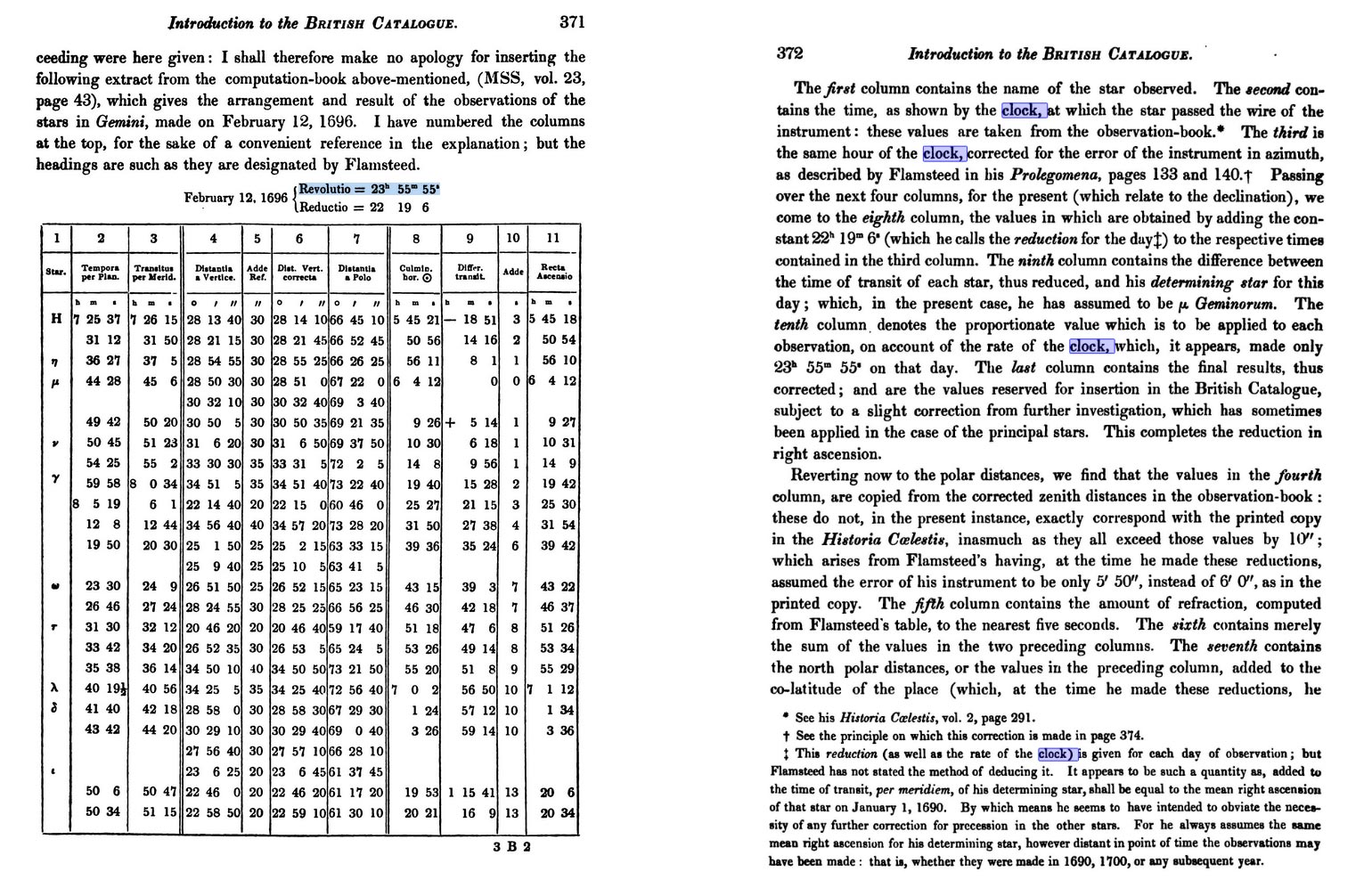
Pages 371 & 372 from Baily's Flamsteed. The table is taken from RGO1/24/21, whilst the page on the right (where references to the clock have been highlighted) explains its structure and how the figures were derived. It is recommended that the pages that follow are also consulted
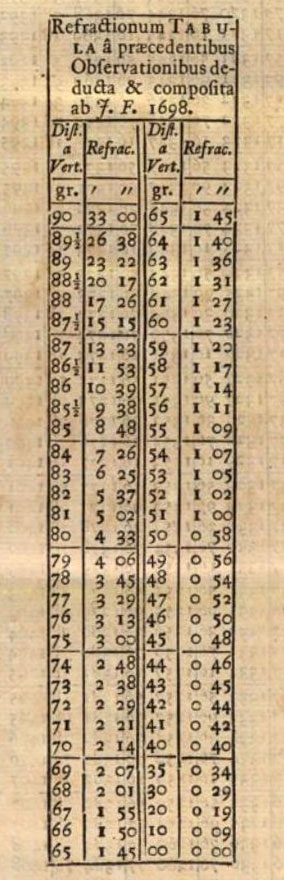
Flamsteed's Refraction Table from Volume 1 of the 1725 Historia. It was published in Volume 2, but without the date of 1698 at the top
It was mentioned earlier that in November 1694 Newton sent Flamsteed a refraction table with different values computed for summer, spring/autumn and winter. Newton also sent a second set on 15 March 1695. According to Eric Forbes [The Gresham Lectures of John Flamsteed p.68] Flamsteed 'based his future corrections to measurements of angular distances and celestial altitudes upon them' though he provided no evidence to support the claim. Indeed, both the computations in RGO1/23 and his published table of refractions (adjacent) suggest that he did not. A search of the catalogue of Flamsteed's papers indicates four sets contain refraction tables (RGO1/47, 52, 54 & 55). All are hand written. RGO1/47 consists of a set of various different tables. The one relating to refraction (RGO1/47/38) is identical in both content and format to the one Flamsteed published in the Historia. The one in RGO1/52 does not seem to exist. That at the end of RGO1/54 is a table with two sets of figures for each degree of ZD, neither of which correspond to Flamsteed's published table or either of tho tables sent to him by Newton, whilst that in RGO1/55 seems is not in a usable form and seems to be mainly a set of calculations. In the circumstances, perhaps the best way forward is to ignore the various tables and see what figures Flamsteed used in practice.
Although there is no mention in the preface to the 1725 Historia about determining right ascensions from time differences, this was clearly something that Flamsteed was thinking about during the calibration of the Mural Arc. In his personal history (RGO1/39) he made the following comment (as transcribed by Baily):
'And now [in late 1689] I saw that the observations, made with this instrument, would have many advantages above Tycho Brahe's made with plain sights. The collimation through the telescopical index was perfect, easy, and accurate; and therefore the observed distances from the vertex exact: which his, certainly in the moon, were not. The observed differences of the times of the transits of any two observable points would give the difference of their right ascensions with much more certainty than his large Armillas, and more accurately; because, here, no bending or inclination of the sights, or misplacing of them, was to be feared. ...
... If the difference of the right ascensions betwixt any two stars, found by the clock, be questioned, it may be examined by the given distance of both from the pole, and their intermutual distances taken with the sextant: of which a large store will be found in my papers and books that contain them; wherein I have always kept them transcribed fair, in such order as I design to publish them if God spare me health and time.'
Halley appears to have been somewhat sceptical about Flamsteed's use of time differences to measure right ascensions. After moaning in the preface to the 1712 Historia about the fact that all the data that he had access to for 1689 onwards been lumped together in chronological order he continued:
'Hence another labor of extracting the Observations of the Planets, and of differentiating them into their classes, and of deducing the right inclinations and declinations from them. Not all the Observations which we find, however, can be printed, namely, the transits of the Stars, whose declinations differ farther from each other, because the perfect plane of the Instrument, and the same perfect fit in the plane of the Meridian is assumed, so that from the time intervals the true differences of the right ascensions are obtained, which seems a daring Hypothesis. Therefore, only those of the Planets in which this difference of declinations was as small as possible have been selected.' (a rough translation derived from Google Translate)
Following this, Halley went on to say that despite this, all the lunar observations had been printed (in the 1712 edition) because of their importance to navigators. Based on what Halley said, we can probably assume that he was unaware of how Flamsteed had calibrated the instrument.
Altitude observations made with a quadrant during the rectification of the Mural Arc in 1689, 1690 and at other times
In the extract from the 1725 Historia in the section immediately above, it is stated that Flamsteed and Sharp together made a 4 plus feet iron quadrant which Flamsteed implies was used in the Arc House to measure the altitude of the Sun. We also know (or have assumed) that the Arc House only had shutters in the roof and the wall(s) in the plane of the meridian. Looking at some of the timings below, it seems unlikely that the equal altitude observations of the Sun were made within the Arc House (as implied by Flamsteed) unless the top of the quadrant was near the roof and the observer was standing on steps.
There is evidence in the observation books that suggests some of the measurements in the table below were made in the Octagon Room rather than the Arc House and the times converted to the equivalent of the Arc House using either the horologium ambulatorium or some other means (for example the two taken on 11 April 1690 and that taken a few weeks later on 14 May where in each case there are two sets of times against each observation (more on this below)). Also of interest is that unlike most of those in Volume 1 of the Histroria, the zenith distances in the observing book are the same as those that have been published.
The dates in the table below are the altitude observations that Flamsteed chose to publish in the Historia. The observations were all of the Sun except those marked with an *, which indicates they were of a star. Times of selected observations are given to the nearest minute (rounded down). Curly brackets { } indicate pairs of equal altitude observations made in April and May 1690, the two sets appearing under consecutive dates (rather than on the same date) as the astronomical day begins at midday.
Year |
Month |
Date (Astronomical) when the altitude
|
|
| 1689 | Sep | 18(3hr 23-31' & 20hr 21-56') | |
| Oct | Oct 4 (4hr 10-17'), 8 (21hr 49-54'), 17 (6 hr 42-51'*) | ||
| Nov | 9*, 16*, 22*, 30* | ||
| Dec | 9*, 13* | ||
| 1690 | Apr | 8 {(20h 15-23'), 9 (3 hr 39-48')}, 10b {(19hr 41-49'), 11(4hr17-25')} & {(19hr 42-51'), 12 (4hr10-18')}, {13 (19hr 41-56'), 14(4hr 03-16')}& {(19hr 46-58') , 15 (3hr 58 - 4 hr 12')} | |
| May | 14 {(19hr 29-45'), 15 (4hr 14-29')}, 22{(19hr 17-29'), 23 (4hr 32-40')}, 25 {(19hr 23'-36), 26 (4hr 27')e} | ||
| Jun | 6, 7, 13, 14, 16, 17 | ||
| Jul | 25, 26, | ||
| Aug | 24, 25, 27(x2), 31 | ||
| Sep | 1f, 14c15(x2)c, 16, 19, 20 | ||
| 1699 | May | 19, 20 | |
| Sep | 11, 12 | ||
| 1712 | Jan | 12*a | |
| 1713 | Jun | 15, 16 | |
| 1718 | Aug | 28, 29 |
a: incorrect hour recorded in published volume 8h11'18 instead of 10h11'18". Also, uniquely, has a column with corrections for refraction, though the figures Flamsteed used bare no resemblance to those in the table above (each being nearly three times larger)
b: recorded as 19hr 41 under the date of 11 April in the observing book, 10 April in the apographa but published under the date of 9 April in the Historia
d: (one) set not reduced
e: only one observation made
f: different column order to normal
One of the many questions that needs to be asked is was the Flamsteed/Sharp Quadrant actually the 50-inch Voluble Quadrant? On the one hand, this seems unlikely as that quadrant came into use on 20 October 1679 before Sharp started working for Flamsteed though it is possible that it may have been reworked by Sharp in later years. One piece of evidence in support of this is that when the newly appointed Visitors compiled an inventory of equipment at their first vistation in 1710, only one 'Quadrant of four feet radius' was listed and that was in the Octagon Room (RGO6/21/11). If the Flamsteed/Sharp Quadrant was a different instrument, given the effort of making it why do so few observations appear to have been made with it (or are there many more that he simply chose not to publish?). Also, where was instrument originally housed given that it was clearly used for making very off meridian observations? One answer perhaps is in the Sextant House next door. But in that case, how was the time on the clock in the Arc House communicated to the observer in the Sextant House? Another possibility (as mentioned above) is that it was in fact housed in the Octagon Room.
Recording adjustments made to the clock in the Arc House
On 10 February 1690, Flamsteed put the Arc House clock forward by 25 minutes. This was recorded in both the observing book, the apographa, and the 1725 Historia. It is the only occasion in the whole of Volume 2 of the Historia where such an adjustment has been found to be recorded. This might easily be taken to mean that there were no other occasions on which the time shown was adjusted apart from when the clock either stopped or when it was cleaned. To be more certain, a proper examination of the observing book and apographas needs to be conducted.
In the 1725 Historia, In the entry for 30 October 1690, Flamsteed records 'purgato prius horologio' (after having first cleaned the clock). The following day, in the observing book, Flamsteed recorded in Latin 'I have put the new clock next the old one in the Arc House, and have set the hands at the same time, 9.39.00.a.m.' Interestingly, although a note in the observing book dated 4 November about Abraham Sharp leaving to teach mathematics was transferred across to the apographa, the earlier note about the new clock was not ... and because the apographa was the volume that Flamsteed ultimately referred to when preparing the text for the Historia, it was also omitted from the published observations .
In Volume 2 of the 1725 Historia, there are just ten references to the clock being cleaned where the word purgato is used. Flamsteed also recorded 25 occassions when the clock stopped (Stetit).
But there are other relevant entries for further research. A word search using the word Indice throws up some, but confusingly for the reader, it is sometimes used in the context of adjustments to the clock (as on 10 Feb 1690 and 1 Oct 1698) but more often it is is about adjustments to the mural arc.
Year |
Stopped |
Cleaned |
|
| 1689 | – | – | |
| 1690 | July 22 | Oct 30 | |
| 1691 | Aug 31 (x2), Sep 11 | – | |
| 1692 | Apr 10 | Feb 2, Feb 12, Apr 16 | |
| 1693 | – | – | |
| 1694 | Jan 20, Feb 25, Dec 11 | Dec 13 | |
| 1695 | – | – | |
| 1696 | – | Apr 2 | |
| 1697 | – | – | |
| 1698 | Apr 12, Jun 16, Jul 25, Aug 15, Dec 11 | Jan 12 | |
| 1699 | – | – | |
| 1700 | Feb 6, Jun 18, Aug 13, Nov 6 | Nov 7 | |
| 1701 | May 3 | Sep 11 | |
| 1702 | – | – | |
| 1703 | Jul 13, Aug 13 | – | |
| 1704 | Apr 2, Apr 10, Oct 24 | – | |
| 1705 | Mar 1, Mar 5 | – | |
| 1706 | – | – | |
| 1707 | – | Apr 4 | |
| 1708-19 | – | – |
In Volume 1 of the 1725 Historia Flamsteed uses the term purgatis rather than purgato when referring to the clocks presumably those in the Octagon Room) being cleaned. Just two references have been found, They occur on 17 Jan 1682 (p.287) and 8–9 Oct 1684 (p.328). On both occasions both of the Octagon Room Clocks appear to have been cleaned. The volume does not appear to tell us anything about adjustments made to the Sextant House clock. Only one reference has been found in Volume 1 to the clocks having stopped (23 May 1681 (p.278)). We do know however from Flamsteed's correspondence, observing books and Howse's research that there were a considerable number of interventions between 1676 and 1678.
Towards a unified time scale (part 1): the arc house clock becomes something approximating to the Observatory's standard clock from 1689 until Flamsteed's death in 1719
Prior to the arrival of the Mural Arc in the autumn of 1689, the times of the observations made in the Sextant House were converted into the equivalent time of the Octagon Room clock prior to being published. Once the Mural Arc came into use, the position was reversed. From that point forwards all the published timings were given in terms of the clock in the Arc House.
Putting it another way: the Octagon Room Clock was used as the standard clock until the autumn of 1689 followed by the clock in the Arc House Clock until the end of 1719.
For various reasons, the evidence trail showing the conversion process is much clearer after 1689 than before it. Because of this, the post 1689 evidence is presented first.
From 1689 onwards, the great majority of observations were made with the Mural Arc (over 25,000). Those made elsewhere were much smaller in number and include: the satellites of Jupiter (about 120 sets), eclipses of the Sun and the Moon, and anything which required the use of one of the micrometers in the Octagon Room (such as the diameter of the moon).
In light of this, an investigation was carried out to see how Flamsteed treated his observations of Jupiter's satellites. In the 1725 Historia, these observations are scattered across over 570 pages of volume 2 (most can be found by using the search term 'Satelles' in a pdf copy). Halley on the other hand extracted the observations (or most of them) from the document Flamsteed had placed under seal with Newton and printed them in a separate section in book 2 of the 1712 Historia.
For the current study, the published times in the two Historias were compared with those in the observing books and the apographa. In the observing books the time of every observation was always recorded in the first column of each page. With the satellite observations however, rather than just one time being recorded a second precedes it (squeezed into the margin at the edge of the page). These are the times recorded in the Octagon Room whilst the time given in the regular column is the Arc House equivalent. The following table is based on the first 15 sets of published satellite observations made after the arrival of the Mural Arc.
Key to column headings:
A) time of observation made in the Octagon Room as recorded in the observing book
B) equivalent time shown by the clock in the Arc House (this was recorded in the observing book,
the apographa and the two Historias)
C) the corrected time as recorded in the apographa and the two Historias
D) the time difference between the Octagon Room Clock and the clock in the Arc House
(+ = Octagon Room clock ahead of that in the Arc house)
E) the time difference between the clock in the Arc House and the corrected time
(i.e. the error of the clock in the Arc House)
A |
B |
C |
D |
E |
||
Date |
Octagon RoomClock |
Clock in ArcHouse |
Corrected time(Ap. & Historias) |
A-B |
B-C |
|
| 1 | 04 Oct 1689 | No record | 08 11 00 | 08 07 46 | – | +03 14 |
| 2 | 17 Oct | No record | 09 08 40 | 09 22 45 | – | - 14 05 |
| 3 | 03 Nov | No record | 07 11 20 | 07 23 45 | – | - 12 25 |
| 4 | 04 Jan 1690 | 05 46 26 | 05 49 14 | 05 50 42 | - 02 48 | - 01 28 |
| 5 | 10 Jun | 38 | 14 54 10 | 14 54 08 | trimmed | +00 02 |
| 6 | 20 Aug | 09 40 | 11 23 09 | 11 21 26 | - 13 29 | +01 43 |
| 7 | 07 Oct | 33 56 | 08 43 10 | 08 40 54 | - 09 14 | +02 16 |
| 8 | 30 Oct | 07 22 30 | 07 30 46 | 07 26 53 | - 08 16 | +03 53 |
| 9 | 22 Nov | 08 36 20 | 08 41 24 | 08 32 49 | - 05 04n | +08 35 |
| 10 | 29 Nov | 03 38 | 11 03 28 | 10 56 48 | +00 10 | +06 40 |
| 11 | 02 Jan 1691 | 49 44 | 06 49 24 | 06 46 28 | +00 20 | +02 56 |
| 12 | 07 Jan | 19 40 | 09 16 04 | 09 14 34 | +03 36 | +01 30 |
| 13 | 03 Feb | 06 36 46 | 06 42 06 | 06 33 26 | - 05 20 | +08 42 |
| 14 | 08 Feb | 05 52 00 | 05 55 44 | 05 50 11 | - 03 44 | +05 33 |
| 15 | 09 Feb | 07 11 44 | 07 15 33 | 07 10 34 | - 03 49 | +04 59 |
Notes:
Line 5: Part of the Octagon Room figure has been lost because the page has been trimmed
Line 6: Apographa has observed time as 11 23 10 rather than 11 23 09 as published in
both editions
Line 9: 1725 version has transcription errors
Line 12. Observing book 'corrections' labeled as 'camera'. a-b for other observations in
this set is 03 35, not 03 36
Line 13. Halley has twice mistranscribed 6 as 0 in the 1712 edition
By 1690, the pattern of recording the Octagon Room timings in the left hand margin seems to have become standard practice. It applied not just to the satellites of Jupiter but to other classes of observations too. For example, when ZD observations of the Sun were taken on 14 May 1690 the Octagon Room clock was 1 minute 25 seconds behind but roughly nine hours later on 15 May the difference had increased to 1 minute 27 seconds.
Of the seven solar eclipses that were observed while the Mural Arc was in use (1694, 1699, 1706, 1708, 1711, 1715 & 1718), the original observations are missing for three of them (1706, 1708 & 1711). Of the remaining four, three conform to the above pattern. The set that doesn't were made during the total eclipse on 21 April 1715 when Flamsteed was very infirm and his writing very spidery and there seems to be mention of a broken clock. The original pattern of recording was resumed for the solar eclipse of 18 February 1718 where the record shows not only that the Octagon Room clock was 10 seconds behind the Arc House clock, but the times recorded in the Octagon Room are actually labelled as such (in Camera Supra).
We don't know how the Octagon Room times were transmitted to the Arc House, but there are a number of possibilities including:
- Using the horologium ambulatorium (a note in the apograha under 29 October 1690 suggests this was the case)
- Using a speaking tube that ran between the buildings (though there is no evidence that such a thing existed
- Shouting the times from the Octagon Room window
- Using a sand timer
The corrected clock times in the above table (column C) are the same in the apograha and both editions of the Historia because they were all based on the reduced figures in the apographa. With many of the later observations, a figure for the corrected time was not included in the apographa. When this was the case Halley had to calculate the corrected time himself. Whilst all the satellite entries in the 1712 edition have a figure for the corrected time, this is not the case in the 1725 edition, where in most cases, if they weren't in the apographa, there is no corrected entry in the published edition. When, a figure was subsequently provided. it always differed from that worked out by Halley.
Although the 1712 & 1725 editions contain most of the satellite observations, some sets are sometimes missing Amongst those missing from the 1712 edition are those made on 25 Oct 1691 and 7 Mar 1692.
As it turns out, there are just thirteen sets of observations where corrected times don't appear in the apographa but do in both editions of the Historia. The times of one observation from each set are given in the table below.
Date |
Obs time |
1725 correction (a) |
1712 Correction (b) |
difference (a-b) |
|
| 1 | 27 Dec 1691 | 08 56 33 | 08 43 | 08 43 18 | - 00 18 |
| 2 | 23 Oct 1695 | 17 28 37 | 17 23 | 17 23 37 | - 00 37 |
| 3 | 10 Jun 1700 | 15 32 58 | 15 26 53 | 15 31 28 | - 04 35 |
| 4 | 31 Aug | 10 58 12 | 11 02 52 | 11 02 37 | +00 15 |
| 5 | 01 Dec | 04 45 15 | 04 49 57 | 04 50 00 | - 00 03 |
| 6 | 07 May 1701 | 15 08 50 | 15 01 05 | 15 01 00 | +00 05 |
| 7 | 15 Jun | 15 30 06 | 15 20 46 | 13 20 56 | - 00 10 |
| 8 | 31 July | 10 16 34 | 10 06 34 | 10 06 30 | +00 04 |
| 9 | 07 Aug | 15 49 09 | 15 33 54 | 15 33 52 | +00 02 |
| 10 | 28 Sep | 10 29 18 | 10 24 43 | 10 24 28 | +00 15 |
| 11 | 20 Oct 1702 | 08 28 33 | 08 31 03 | 08 30 58 | +00 05 |
| 12 | 16 Nov | 05 57 25 | 05 55 05 | 05 56 45 | - 01 40 |
| 13 | 22 Sep 1703 | 08 09 13 | 08 09 43 | 08 09 33 | +00 10 |
But what were they correcting to? Apparent time of corrected clock time? As mentioned earlier, in the apographa, only the first three pages of the first volume (ie up until 4 October 1689) have a heading in the second column (Tempora correcta) . None of the pages of the second volume have the heading filled in. But in the third volume (which covers the period 11 Jan 1704 to 12 Nov 1715), the words Tempora Correct appear at the top of the second column on every page.
Although only a sample of observations have been studied, it is important to mention the shockingly large number of transcription errors, some of which have already been mentioned. Here are a couple more from the 1725 edition: 25 Feb 1694 and 7 August 1701 (p.421) where some of the timings (not those in the above table) not only differ by an hour from those in the apographa, but are not corrected in the errata either.
Towards a unified time scale (part 2): the Octagon Room clock becomes something approximating to the Observatory's standard clock until 1689
Although the evidence trail is very different, it is quite clear that prior to 1689, the times of all Flamsteed's observations in the Historias are given in terms of the time shown by the clock in the Octagon Room.
As was the case post 1689, the majority of observations were not taken in the Octagon Room, but elsewhere – in this case in the Sextant House. However, although Flamsteed was able to determine the error of the clock in the Arc House from the Sun's time of transit, he had no direct means of determining the error of the Sextant House Clock. But he did have the means of determining the error of the Octagon Room Clocks from his observations of the altitude or ZD of the Sun or selected stars.
Unlike the post 1689 situation where only a minority of the total observations made need converting, prior to that date most of them did. In addition, post 1689 there was only a relatively small time difference between the first and last observation in each set that needed converting. This was in marked contrast to the earlier observations where a whole day's worth of several hours worth of observations might need converting.
Unlike the errors of the clock in the Arc House, the errors of the Octagon Room Clock were explicitly published with the observations of the Moon in both the 1712 and 1725 Historias. An examination of the Lunar observations (which run to over 150 pages) shows quite clearly these figures for the clock errors were used to correct the 'observed' times recorded with the Equatorial Sextant. But as with the post 1689 observations, there is nothing in the Historia to suggest that any of the 'observed' times have in fact been adjusted.
The first records where both the time on the Sextant House Clock and their Octagon Room Clock equivalent are recorded only seem to start in the observing books in the 1680s. There are several examples in Aug 1682 when a comet was being observed. At this point, Flamsteed used a variety of methods of recording, including some occasions when a note was added saying add or subtract a certain number of minutes and seconds. On these occasions, the times recorded are those of the Sextant House Clock but those that were published have had the adjustment applied. An examination of the observations made in September 1684 shows that there are seven consecutive entries where there are two times given for each observation. Unlike the post 1690 observations, the original time of observation is recorded in the main column, with the adjusted time (ie the one that was published) recorded in the left hand margin.
Under the date of 19 Jan 1683 in the observing book, there are two columns with times in. Those in the second (i.e. the ones that were published) were clearly written in later as the numbers appear much bolder. They are all 4' 38" ahead of those in the additional column. On 9 June 1684 (RGO1/3/13) all the timings have an additional time to their left which is 34 seconds less. The figures in the second column all reconcile with what was later published in the Historia. p.372. Likewise 12 June 1684 where the figure is 35 seconds less (also p.372) and June 16 when it was 40 seconds less. Also Sept 16/17 1684 when it was 2'28" less .p327 (misnumbered as 323). Examples like the above where both the original and adjusted figures appear in the observing books are few and far between. It is surmised therefore that what is recorded in the observing books was copied in from ephemeral records now lost.
Those entries where such records do exist tend to relate to short sets of observations made in a relatively short timescale where the same conversion factor has been used for each observation within the set. What needs further investigation is what happened to sets that were made over several hours, especially at times when the clock's rate was changing rapidly. This is not straight forward and may not actually be possible. However the observations recorded in the observing book at the end of 1683 possibly allow a degree of insight into Flamsteed's methods.
Mention was made earlier of a correction of 1h1'40" being published against the observed time for the observations of Jupiter's satellites that were made on 3 January 1684. An examination of the observing book shows that from around the start of November 1683 the rate at which the Octagon Room clock was gaining began to increase at an ever more alarming rate necessitating an adjustment of 40' on 3 December and a further adjustment of 1h10" on 4 or 5 January 1684.
The following table shows the clock error as determined by measurements of ZD during this period (dates and times are civil times):
Date |
error |
Published? |
Comment |
Days |
Change(s) |
ApproxRatea |
CommentPublished |
|
| 27 Oct 1683 | - 05' 05" | ✓ | ||||||
| 08 Nov | - 10' 44" | x | 12 | 339 | 28 | |||
| 15 Nov | - 16' 00" | ✓ | 7 | 316 | 45 | |||
| 19 Nov | - 19' 02" | x | 4 | 182 | 46 | |||
| 23 Nov | - 23' 36" | ✓ | 4 | 274 | 69 | |||
| 01 Dec | - 32' 07" | x | 9 | 511 | 57 | |||
| 03 Dec | + 05'03" | ✓ | Put back 40' | 3 | 170 | 57 | ✓b | |
| 13 Dec | - 10' 18" | x | 10 | 921 | 92 | |||
| 18 Dec | - 17' 48" | ✓ | 5 | 450 | 90 | |||
| 20 Dec | - 20' 11" | x | 2 | 143 | 72 | |||
| 21 Dec | - 23' 27" | ✓ | 1 | 196 | 196 | |||
| 25 Dec | - 33' 27" | x | 4 | 600 | 150 | |||
| 28 Dec | - 40' 16" | x | 3 | 409 | 136 | |||
| 01 Jan 1684 | - 53' 25" | x | 4 | 789 | 197 | |||
| 04 Jan | - 1h01'45" | x | 3 | 500 | 167 | |||
| 4/5 Jan | Put back 1h10' | x |
a) The figures for the rate in the above table have been calculated on the basis that each set of observations was taken at the same time of day. As a result, there could be large errors, particularly when the time gap between observations is small. To calculate the rate properly, the elapsed time between successive sets of ZD measurements needs to be known in terms of days and fractions thereof. The times in the observing book are recorded using civilian time and more importantly a 12 hour rather than 24 hour time system. Unfortunately, Flamsteed did not always specify if an observation was taken in the morning or the afternoon. At present, resources are not available to establish if those that are unspecified were made in the morning or the afternoon.
b) Put back shortly before measurement.
The rapidly changing rate clearly presented a problem as not one of the eight observations made on 27 December and the 36 observations made on the 29 December and recorded in the observing book has a time for when the observation was made recorded. Nor does the single observation made on 2 Jan. This suggests:
- The observations were copied into the observing book at the end of each day's observing
- Had the times been filled in, a different correction figure would have been needed for each observation, but Flamsteed did not have sufficient data with which to calculate it.
- Flamsteed may not have been up to date working out the clock error from his ZD observations
The above examples are not isolated cases of observations being recorded with no times against them. Another occasion when a whole day's work was wasted was on 11 November 1679.
It is also worth noting in addition to the above, that none of the observations made after 21 December during this period were published apart from the observations of Jupiter's satellites. An examination of the observing book hows that the observation of Jupiter's satellites made on 3 January 1684 was made at a clock time of 20h14'40" and that three measurements of the ZD were made a few minutes later over a period of about five minutes at 20h17'24", 20h20'10" and 20h22'02. The associated clock errors were 1h01'40", 1h01'46" and 1h01'48". It was the first of these that was used to calculate the corrected time that was published in the Historia.
This seems to be down to the continually evolving way that timings were entered into the observing book.
The following points need to be considered:
- The observing books record all the observations in chronological order irrespective of where the observation was taken
- In the observing books, times recorded in the Sextant House are given to the nearest second, but in some, sections of the published observations, they are only given to the nearest minute
- Only a very small number of direct comparisons between the Octagon Room Clock and Sextant House Clock have been identified (Camera Supra etc)
- Although there are lots of observations used to determine the error of the Octagon Room Clock(s), no such observations have been found for the Sextant House Clock
- In the observations of the Moon's approach to fixed stars made with the sextant and other instruments (Vol 1, part 4), there does seem to be a discrepancy between the times recorded alongside the Sextant observations and those that were published. For example, the published times for 8 Feb 1677 are 28 seconds ahead of those in the observing book (there is also a typographical error), but on that day, Flamsteed records that the error of the Octagon Room Clock is 12 minutes 40 seconds which is the correction then applied to the Sextant House Clock.
- But on 14 Jan 1681, no correction appears to have been applied to the published clock time (Tempora per Horologium Oscillatorium), though the figure in the column Tempora ex Altitud.Correcta has been corrected by roughly the error determined by altitudes in the Octagon Room roughly 141.5 hours earlier.
- On 23 July 1683 a similar situation arises
So was Flamsteed using a standardised time system based on the Octagon Room Clocks? If it was, the challenge is to find something in the observing books (or elsewhere) that shows how and when the Sextant House clock was compared with those in the Octagon Room.
Flirtations with sidereal time and Newton's demands
Flamsteed seems to have flirted with the idea of using sidereal time both when he was appointed Astronomer Royal in 1675 and again in the 1690s. Normally, there is no physical distinction between a pendulum clock set to mean solar time and one set to sidereal time except for a small difference in the effective length of the pendulum. Most clocks can be adjusted to accommodate both systems. Flamsteed however commissioned specially designed clocks on both occasions. Neither appears to have been successful.
The first clock was designed to beat 44 times a minute and had a pendulum that was 6 feet and 1/10 an inch long. There is nothing in the observing books to suggest that the clock was ever used in practice, which raises the question of whether or not it ever even existed. The first mention of it comes in a letter from Flamsteed to Towneley dated 11 December 1675 where Flamsteed appears to be asking him to make the movement:
'But yet hee [Jonas Moore] thinkes your pallets may doe better and therefore intends to write to you to get us a movement made. onely to shew the hour minute and second, with pallets after your way. wee thinke that the longest pendulum and the heaviest weights will be least subject unto alterations by weather or clogging in the piveot holes with dust which will sometimes happen though the utmost care be used to prevent it and therefore I would, if my advice were worth the taking, move to have your pendulum make 44 vibrations in a minute which to doe it will require that the length from the center of the Axis to the center of oscillation be about 72 7/10 inches long, and that the wheeles were fitted with numbers for it and contrivd to goe a weeke or more without winding up. Sir Jonas desires onely the bare movement for the face and fingers made be added here without further troubling you.'
The next mention of it comes in a letter dated 22 January 1676 in which Flamsteed appears to be telling Towneley that the clock will be placed in the Octagon Room.
'Accordeing to my promise in my last I here send you a draught [a plan] of the new building on Greenwich hill done by a scale of 20 foot in the inch I had designed you a better but had not leasure to perfect it at present, nor to draw a prospect: but hope this will satisfie you till I may have leasure for both: It were much to be wished our walls might have beene Meridionall but for saveing of Charges it was thought fit to build upon the old ones which are some 13°1/2 false and wide of the true meridian as you will find by the wall of the Watch [Quadrant] house. our great roome being 20 foot high will be capable of a long pendulum to be hung above the clock but you need not be solicitous to make the Motion I wrote of for so high a place because I designe it for another where wee shall have lesse roome but that I permit to your discretion and shall place it where it may have roome sufficient.'
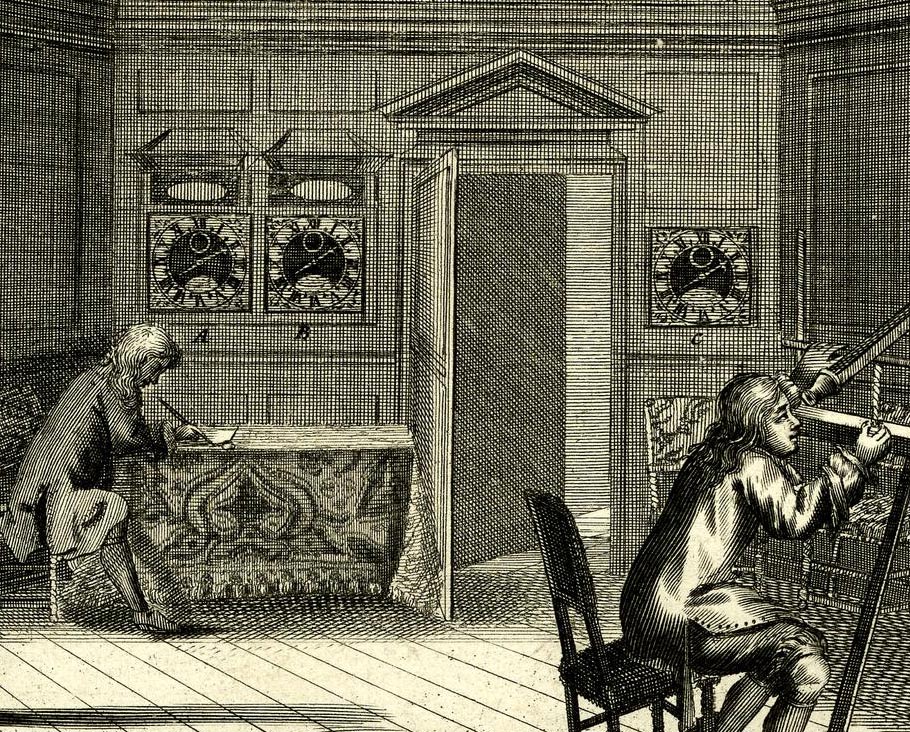
Detail from the etching above showing the two Tompion Clocks (to the left of the door) together with the clock currently under discussion. © The Trustees of the British Museum (CC BY-NC-SA 4.0). Museum number: 1865,0610.952 (see below)
The proposed clock is thought to be the one shown to the right of the door in the image above. Given that it had a beat time of 1.3636 seconds compared to the two seconds of each of the two clocks Tompion Clocks, it seems unlikely in practice that its dial would have been exactly as shown. It is therefore surmised that the drawing from which the etching was made was created prior to the clock being installed (if indeed it ever was).
Over a year later, in a letter to Towneley dated 3 November 1677, Flamsteed mentions a 'pendulum' made by Towneley's servant; but it is rather unclear not only whether it belonged to the above clock, but also, if it did, if Flamsteed planned to move it from the Octagon Room to the Quadrant House. This is what Flamsteed wrote:
'I set our Meridian Wall [in the Quadrant House] by the Pole star and now I find by some trialls of the **s culminations that its deviation from the true Meridian is scarce sensible. by this I intend to examine the clocks for the future by the transits of 4 more fixed ** s that may have nearely the same declination and passe over it nearely in aequall altitude. by this meanes I shall find whether the earths revolutions be allwayes Isochronicall which is not yet clearely made out. and if they bee I shall find the aequation of days by experiment. for I intend to cause that pendulum your servant made mee to count the sidereall houres of some star neare the vernall aequinox. which if it be noted from this clock at any time when the suns height is taken if to that time you subtract the suns meane motion from the star converted into time, the difference of this hour so found from the hour found by the suns height will be the aequation of dayes. I know not whether I imparted this to you formerly if not I desire your opinion concerneing it.'
As noted above, there is nothing in the observing books to suggest that the clock was ever used in practice. What we do know however is that in the 1950s when the Octagon Room was being prepared for opening to the public, evidence was found behind the wall above the position of the dial to the right of the door that was consistent with a clock having once been mounted there (see Howse p.125 for more on this).
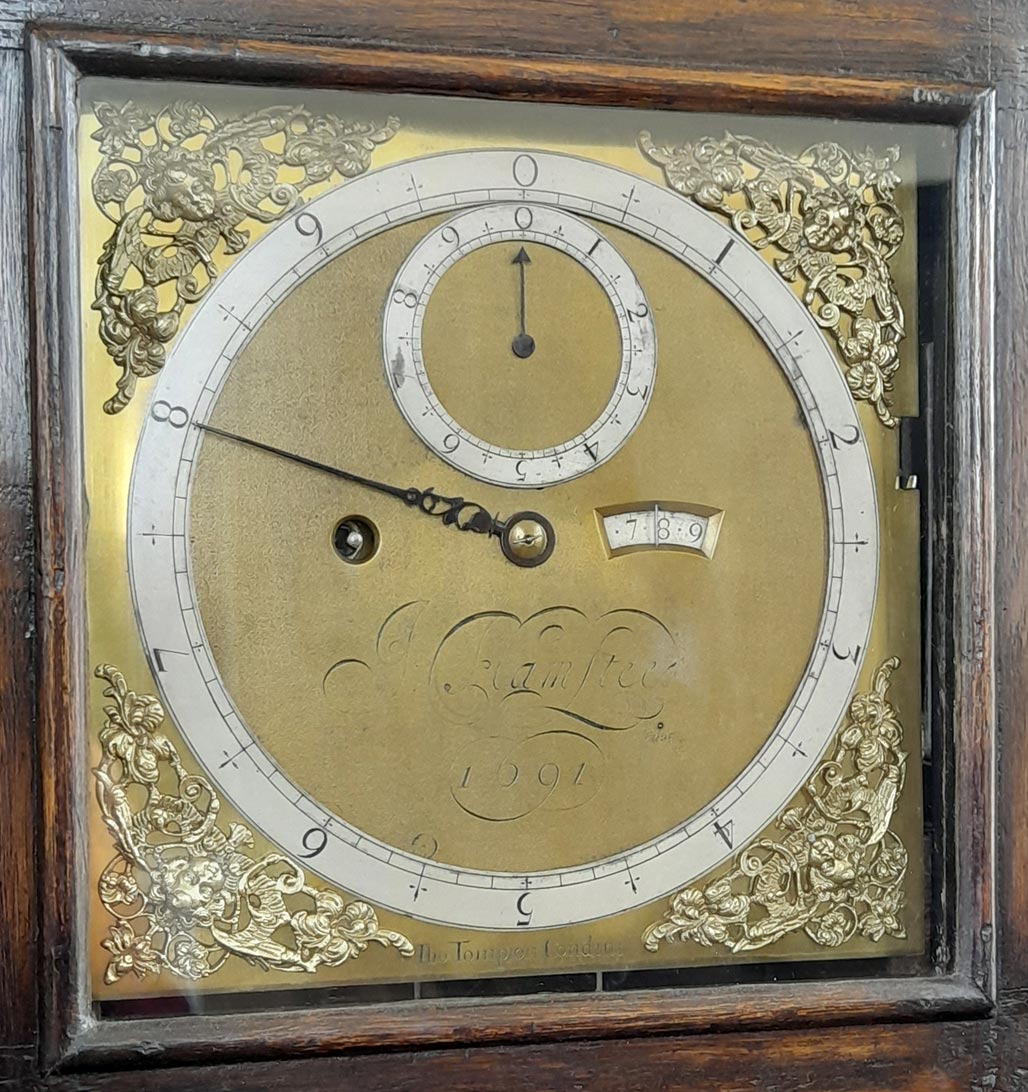
An oblique view of the dial of the Degree Clock. Signed Tho Tompion London, the dial also carries Flamsteed's name and the date 1691. The rotating disc in the curved window (showing the numbers 7, 8 & 9) is marked in 10° intervals from 0 to 35. The large dial is marked every 10' of arc whilst the small dial at the top is marked every 10" of arc. The clock (which was not running when the photo was taken) is reading 78°0'0". Photograph: May 2022
On 15 January 1695 in a letter to Flamsteed, Newton asked him if he would stop using Tempus Apparens (apparent time) and start using sidereal time instead.
'In trying to compute the mean motion of the Moon from the tempus apparens in some of your observations. I find that the mean motion gathered by my computations differs sometime from that in your Synopses 5" or 6" or above. Which makes me suspect that in determining the tempus apparens, your servant followed some tables which are not sufficiently exact: such as are those which Tompion uses for his watches. For those err sometimes 6" or 8". For avoyding this inconvenience I desire you would instead of the Tempus apparens, use sidereal hours counted from the appulse of the Equinoctial point to the meridian, or rather from that of the Dogg starr or of some other notable star. If you use canicular hours counted from the appulse of the Dogg-starr to the meridian you may note them thus (1695 Jan 7. 5hc. 44'. 15".) putting hc for hora caniculari. By this means the equation of time will be wholy avoyded which is troublesome to calculate and makes the work liable to errors. For where the equation of time must be considered it must be twice, computed; first to get the tempus apparens and then to get the tempus verum [true time], which is to go a great way about. For in the way which I propose, the time in canicular hours is the tempus verum and its found without any other labour then by seeking the right ascention of the Dogg-star from the meridian and turning it into time. But that there may be no mistake in the day to which the canicular hours belong I would count them from the appulse of that starr to the meridian next after the midnight which precedes the day, that is, which comes between the midnight which begins and the midnight which ends the vulgar day. So that for instance, the canicular day which begins at any time between midnight and midnight on Jan 7 shall be called Jan 7: and so of all other days.'
Flamsteed replied on 18 January writing:
'You advise to use the sydereall hours in the roome of the usuall and Vulgar. You may remember I have a New Contrived Motion [the degree clock] for that purpose in my Quadrant house that Numbers the degrees minutes and sixths of the equator. provided this two yeares for that purpose. but to vary from the Common way of reckning onely to shun the account of the aequation of days is needless when it is so easily found and allowed for. I intend to try how it will succeed when the weather grows a little warmer that I may be sure the frost shall not by thickning the oyle spoyle the goeing of my Movement but I shall Count not from the Dog star but the vernall equinox because it will be most Convenient on severall accounts that will occur to you on the first thought. but still I shall not omit the old usuall Way of Numbring the solar hours with it.' (MS Add.3979)
Writing again on 26 January, Newton commented:
'Whether the sidereal hours be counted from the equinoxial point or from the Dog star, is of no great moment. The computation is readier from the equinoxial point, but the star is a point better defined and immoveable, and its proper to refer the motions and positions of things moveable to the positions of things immoveable.'
After this, the subject seems to have been mentioned just once more. In a letter to Newton dated 7 February, Flamsteed wrote:
'Tis true the aequation of dayes may be avoyded by accounting of time in sydereall hours. But this is a change that none but those who are versed in Astronomy would easily understand and therefore not to be made because. it departs too far from the sence of the common people and reproaches them with ignorance which would cause them againe to deride us. but further I doe not thinke that hereby wee should avoyd all appearance of error for I find the parallax of the orbe is sensible even in the pole star, tho it be but of the 3d light, Whence it will be argued that it is much more so in Syrius, the briskness of whose light and the bigness of his body shew that he is much nearer to us then the rest of the largest stars in our hemisphere. yet I argue his nearness to us more from the briskness of his light then the bigness of his body, for I thinke the difference in the strength of ♃ light. when he is nearest the earth and when remotest from it, is much more then in proportion to the difference of his distances.'
The reference to the thickening of the oil in the second letter is interesting given that all the other clocks seem to have run satisfactorily in cold weather. Also curious is that the only record of the clock actually running dates from 1694 and consists typically of around three comparisons a day being made between it and the Arc House Clock on March 15, 16, 17, 18, 19 and April 4 or 5 (RGO1/6/180). At present, we can only speculate as to why Newton's request was apparently unfulfilled and why Flamsteed, who was always complaining about the cost to him of his instruments, wasted money on a clock that he seems to have been less than enthusiastic about in practice.
The clock is now in the collections of the National Maritime Museum where extensive records of the clocks going during the 1970s and 80s are preserved. A proper examination of these may help shed further light on the matter. Also of interest is the fact that today, the clock can be used in a different mode by changing the pendulum for one that beats seconds (i.e. one about a metre long) and reversing the degree disc which has markings on the rear that run from I to XII. In this mode, the clock indicates parts of an hour to two places of decimals, though the graduations between figures are not meaningful. Whether this feature was included from the start is not known, but seems doubtful. It seems likely that Flamsteed or a later owner had the clock adapted, perhaps for domestic use. A future comparison of the engraving on the two sides of the disc might shed some light on the matter.
Demonstrating that both the swing of a clock pendulum and the spinning Earth are isochronal
One of Flamsteed's first investigations at Greenwich was to check if the swing of the pendulums of the two clocks in the Octagon Room was isochronal, and if this was the case, to use them to establish if the spinning Earth was too. By 1678, possibly with the help of a fixed telescope set up in 1677 with which to observe the dog star Sirius and the Octagon Room clocks, he was satisfied that it was. Somewhat surprisingly Flamsteed did not publish a paper announcing his findings. Also of some concern is that to date, the evidence on which he based his conclusions has not been found.
Flamsteed described the Sirius telescope and his use of it in a letter written to Richard Towneley on 24 March 1677:
‘…I have now fixed a payre of convex glasses of six foot focus in brasse cells upon an Iron Ruler to one of our Walls and three or 4 times observed the transits of Sirius over it. my last note was the 21th instant when hee passed it 3 min before 5 a clock at which time the sun was more than 10 degrees high and yet I saw the star as plainely as you usually see the planet♀ [Venus] upon the sun rise in winter with your bare eyes…'
Although a record on this and three earlier observations made on 23 & 27 February and 19 March have been located in the first of Flamsteed's observing books, a preliminary search has so far failed to find any later ones. Indeed at the end of the volume a short composite table of the Sirius observations compiled by Flamsteed has no enties after that of 21 March (RGO1/1/203).
The question therefore arises did Flamsteed abandon the Sirius Telescope or did he keep a record of the observations in a separate book or on loose sheets now lost?
It is also worth noting that we only know of the existence of the Sirius Telescope through Flamsteed's correspondence with Towneley. There it is mentioned on just three occasions. On 11 December 1676 Flamsteed wrote:
'I have got a payre of 5 foot glasses which I intned to apply to a wall whereby I doubt not but hearafter I may find the errors of our clocks to greater exactnesse.'
The letter of 14 March 1677 is mentioned above. In the third letter, which is dated 5 April 1677, Flamsteed mentions that he might use 'the wall telescope' to check the going of the two Tompion Clocks.
The issue of isochronism was also discussed with Towneley in other letters and a study of these may shed more light on how Flamsteed came to his conclusions.
Misunderstandings
As will have been seen by what has been written above, understanding how Flamsteed operated is far from straight forward. One of the problems not mentioned so far is that Flamsteed lacked consistency in what he wrote leading to discrepancies between what he wrote in the Historia, his correspondence and his other manuscript records.Today we not only have much more data available than in the past, but parts of it are available in a digital format which is easier to interrogate. It is hardly surprising therefore that serious misunderstandings have crept into the literature. These need correcting, especially as many are attributable to individuals who are experts in the field. In pointing them out, one is acutely aware of the proverb that 'people in glass houses shouldn't throw stones' given the likely possibility of errors, misunderstandings and omissions in what has been written above.
*****
In her book Under Newton's shadow: astronomical practices in the seventeenth century (1985), Lesley Murdin incorrectly wrote (p.129):
'To find the error of his clocks, Flamsteed attached two 5-foot telescopes to a wall so that he could take the times of well observed stars crossing the Meridian'
*****
In his book John Flamsteed (1999), John Birks writes p.60:
'In addition to the two Great Clocks in the Octagon Room, which were the standard reference clocks kept accurate by stellar sightings, Flamsteed had another pendulum clock to use in his work. In the Sextant and Quadrant House he had a secondary standard clock to use in his recordings of transit times, ... The first clock in the "Arc House" ... was replaced in 1690 by another clock'.
The implication here is that the Octagon Room Clocks were the reference clocks until Flamsteed's death at the end of 1719.
*****
In the paper Flamsteed's Lunar data, 1692-95 sent to Newton, Journal for History of Astronomy, xxvi (1995), 237-246, the authors Nicholas Kollerstrom and Bernard Yallop made at least two questionable statements:
'This displacement concurred with times given for stellar meridian transits in the [1725] Historia’s Book II: thus, six stellar transits for 1691 averaged 5’ ± 2’ due east of south, while for 1695 the figure was 8’ ± 2’. Such a displacement would make all his meridian readings half a minute too early. Forbes [Royal Observatory vol 1, 1975 p.48] Greenwich claimed that Flamsteed corrected for this: “[Flamsteed] determined that the transit on the tropic occurred 38 seconds earlier than it should have done, indicating that the alignment of the instrument was then 9½' west of the true meridian”. For a south-facing instrument, a too-early transit implies a deviation to the east! We found no indication that Flamsteed had made such an adjustment.'
As can be seen from RGO1/23&24, Flamsteed did correct his transit times for the misalignment of the Mural Arc when computing his star catalogue. What he did not do is publish the corrected figures with the observations, but he did mention how he determined the errors in the preface to the volume (see section on 'Rectifying the Mural Arc' above).
Later in the paper, the authors wrote:
'Newton sent seasonally adjusted tables of refraction to Flamsteed in November 1694, followed by a further table in March 1695, claiming the latter was accurate to one second of arc above 10° and to two below. According to Eric Forbes [Gresham Lectures, p.68] Flamsteed used these tables.'
Although the authors quote Forbes accurately, Forbes himself was probably incorrect (see the section above titled 'Rectifying the Mural Arc' for details.
*****
In his book Greenwich Time and the longitude (1997) which was previously published in 1980 as Greenwich Time and the Discovery of Longitude, Derek Howse, in Appendix II, incorrectly states that equal altitude measurements of the Sun were the principle method used for finding the true time at the Observatory between 1676 to 1725. As we have seen, they were rarely used after the Mural Arc came into use and even before then, most time determinations were made with single sets of altitude observations made either before or after the Sun (or star) had transited the meridian. It is possible that this misunderstanding stems from something that Eric Forbes wrote in volume 1 of Greenwich Observatory which was published to celebrate the Observatory's tercentenary in 1975 (see below).
*****
In volume 1 of Greenwich Observatory (1975) p.31&32, Forbes not only states that equal altitude observations were used to regulate the Tompion Clocks in the Octagon Room, he also seems to have taken it as a given that the third clock in the Octagon Room actually existed and that it was regulated to sidereal time using the Sirius telescope. However, only four records have been since been found of Sirius being observed with the telescope and what's more, all the timings were made using the Tompion Clocks which were regulated to mean solar time.
*****
In his book Dividing the circle (1990) p.50 Alan Chapman states that the Sirius Telescope was used to establish that the Earth was spinning at a steady rate.
Further reading
An analysis of the errors in John Flamsteed's Mural Arc observations. William Blitzstein (1997)
Flamsteed's Star Catalogue. Pierre Barbier
Acknowledgements and Image licensing
The images from the British Museum are reproduced under an Attribution-NonCommercial-ShareAlike 4.0 International (CC BY-NC-SA 4.0) license, courtesy of the The Trustees of the British Museum. All have been cropped and recompressed for this website.
1. The Octagon Room: Museum number: 1865,0610.952.
2. The portable clock in the Summer House Museum number: 1865,0610.953. (detail)
The following is reproduced courtesy of the MDZ (Münchener DigitalisierungsZentrum) under a No Copyright-Non Commercial-Use license
The following image is reproduced under a Creative Commons Attribution-ShareAlike 4.0 International (CC BY-SA 4.0) license courtesy ETH Zurich and is taken from the 1712 edition of Flamsteed’s Historia.
- Headpiece (detail)
© 2014 – 2026 Graham Dolan
Except where indicated, all text and images are the copyright of Graham Dolan